

Facial Fat Grafting
Restoring volume and facial balance using your own fat, carefully placed to support natural contours and tissue quality.
The face changes over time not only through reduced skin elasticity or descended tissue structures. The distribution and volume of fat tissue also change. Areas that once blended softly into one another can appear flatter or more sharply separated.
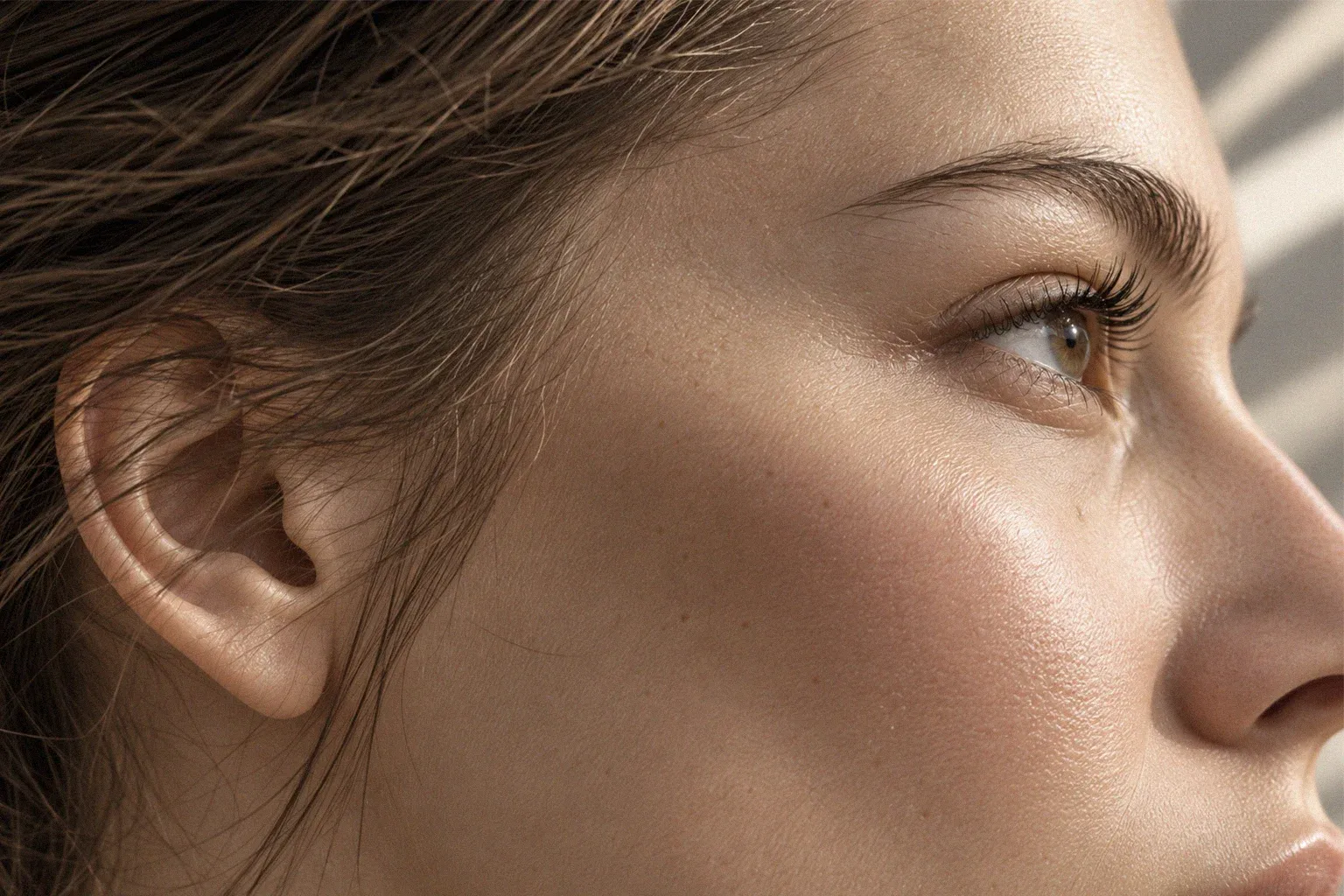
These changes can particularly affect proportions and expression in the midface, the cheeks, the temples and around the eyes.
A fat transfer addresses this directly. Fat is taken from another part of the body, processed, and placed in a targeted way into selected areas of the face.
The aim is not to add as much volume as possible. It is to restore lost volume where it plays a role in the natural contours and proportions of the face.
At Clinic Selnau in Zürich, we plan facial fat transfer with particular attention to volume distribution, facial proportions and the most natural possible transition between individual regions.
Our Approach
Every face has its own volume distribution.
Bone structure, fat compartments, skin quality and the position of the soft tissue together determine the contours of the face. As we age, these structures can change in different ways.
For this reason, a fat transfer does not begin with the question of where volume can be added. What matters, rather, is where volume has actually been lost, and what effect that loss has on the face as a whole. We look at the transitions between the temples, cheeks, lower eyelids, midface and lower face. This equally involves deciding which areas should deliberately not be treated.
Volume, Contours & Proportions
Volume plays an essential role in how a face is perceived.
It influences how light and shadow fall across the face, how clearly individual contours stand out, and how harmoniously different facial regions blend into one another.
With age, volume can decrease or shift in certain areas. At the same time, the skin, bone structure and deeper tissue layers change as well. Filling individual lines in isolation would therefore not adequately reflect these connections.
A fat transfer to the face may be considered for changes including:
- Volume loss in the cheek area
- Flattening of the midface
- Volume loss at the temples
- Deepened transitions between the lower eyelid and the cheek
- Changes to the contours of the lower face
- Age-related loss of soft facial transitions
- Asymmetries in volume distribution
- Volume deficits following previous surgery or injury
- A wish for treatment using the body's own tissue
Not every hollow or line results from missing volume. Descended tissue, excess skin or changes to the deeper structures can look similar but require a different treatment approach. What matters, therefore, is first understanding the cause of the change.
Planning & Analysis
A careful analysis of facial proportions is an essential part of planning.
During consultation, we examine your face from different perspectives. We assess not only individual volume deficits, but also their relationship to the surrounding structures. The cheeks, midface, temples, eye area and lower face are considered in relation to one another. Existing asymmetries and your natural bone structure are also factored into the planning.
Standardised photography supports this analysis and helps define the areas where volume replacement may be meaningful.
Equally important is the assessment of the skin and soft tissue. Volume alone cannot correct descended tissue or pronounced excess skin.
Planning is therefore guided not by how much fat can be transferred, but by where it should meaningfully be used for the proportions of the face.
The Procedure
For a fat transfer, a small amount of fat tissue is first taken from a suitable area of the body.
The harvested fat is then processed and placed in small amounts into the intended areas of the face. Distribution takes place across different tissue levels and is guided by individual anatomy and the desired volume correction.
Some of the transferred fat cells can integrate permanently into the surrounding tissue. Another portion is reabsorbed by the body during the healing phase. For this reason, the final volume is not assessed immediately after treatment. Only once the early healing phase has passed can it be better estimated how much of the transferred tissue will remain long-term.
This treatment therefore calls for restrained planning. Overcorrecting in an attempt to fully anticipate future volume loss can lead to unnatural proportions. What matters is a controlled distribution of the fat, guided by individual anatomy.
Fat Transfer or Dermal Filler?
Both fat transfer and dermal filler can be used to change the volume and contours of the face. They differ fundamentally, however, in material, technique and treatment planning.
Dermal fillers allow for targeted treatment using an injectable material and can be particularly useful for smaller or very precisely defined corrections.
A fat transfer, by contrast, uses the body's own tissue. This requires fat harvesting beforehand, and the volume that ultimately remains depends on how much of the transferred tissue integrates successfully.
Which method makes more sense depends on the area being treated, the volume required, tissue quality and your individual preferences. The decision should therefore not be based solely on which material is preferred. What matters is which treatment is suited to the underlying change.
Volume and Tissue Position
Not every volume loss should be treated in isolation.
Where tissue in the mid or lower face has descended significantly, added volume alone cannot restore the original contour. In some situations, too much volume can even make the face appear heavier or less defined.
For this reason, we distinguish between missing volume and altered tissue position. For more pronounced changes, a facelift may be more appropriate, or it can be combined with a fat transfer. A facelift changes the position of descended tissue, while fat can be used in a targeted way where volume has additionally been lost.
Following a previous facial operation, fat transfer can also form part of an individual treatment concept within a revision facelift.
Volume can support contours. It cannot, however, replace a necessary repositioning of tissue.
Complementary Treatments
Facial ageing often affects several anatomical layers at once.
A fat transfer can therefore be performed as a standalone treatment or combined with other procedures.
Changes at the transition between the lower eyelid and the cheek, for example, can result from both volume loss and changes to the lower eyelid itself. Depending on the starting point, a lower eyelid lift may therefore be appropriate on its own, or in combination with fat transfer.
An upper eyelid lift, a brow lift or a forehead lift can likewise be assessed independently for corresponding changes in the upper face.
Where descended tissue in the lower face or changes along the jawline are the main concern, a facelift can be appropriate. Changes to the neck are assessed separately as part of a neck lift.
A lip lift, in turn, addresses the anatomical proportions between the nose and upper lip, and therefore pursues a different goal than pure volume replacement.
Where the primary concern is skin quality rather than volume, biostimulators or a broader regenerative facial rejuvenation concept may be more appropriate, either independently or in combination with fat transfer.
Combining several treatments is not automatically necessary. What matters is which anatomical change is actually present, and which procedure is suited to it.
Fat Is More Than Volume
Fat is often understood primarily as a way to add volume.
Its significance in the face, however, goes beyond that. Fat tissue is living, autologous tissue and contains various cellular components that interact with the surrounding tissue.
Once successfully integrated, the transplanted fat becomes part of the treated area. Alongside the volume effect, this can also bring changes in soft tissue and skin quality. These possible effects, however, vary from person to person and should not be equated with a guaranteed regenerative result.
The decisive advantage of fat transfer remains the ability to use the body's own tissue in a targeted way, exactly where volume is needed for contour and proportion.
It is not about making the face fuller. It is about returning volume to where it belongs within the natural structure of the face.
Healing & Results
After a fat transfer, the treated tissue needs time to stabilise.
Swelling and bruising can occur both in the face and at the donor site. In the early healing phase, the treated face therefore often appears fuller than the eventual result.
Some of the transferred fat tissue is reabsorbed by the body over the following weeks and months. The remaining portion can, once successfully integrated, become a lasting part of the treated tissue.
How much volume is retained varies from person to person and cannot be predicted exactly. In certain situations, a further treatment at a later stage may therefore make sense.
Even fat that has integrated long-term remains subject to the body's natural changes. Weight fluctuations and ongoing ageing can influence the result.
The final result should therefore only be assessed once swelling has subsided and the transferred tissue has stabilised.
Consultation
A fat transfer begins with the question of which changes are actually the result of volume loss.
During your consultation at Clinic Selnau in Zürich, we assess your facial proportions, volume distribution and the quality of the skin and soft tissue. Individual regions are not considered in isolation, but in relation to the face as a whole.
We discuss which areas can benefit from targeted volume replacement, and where a different treatment may be more appropriate. We also assess whether sufficient suitable fat tissue is available for harvesting, and which area of the body is best suited for this.
On this basis, a treatment plan is developed that is guided by your anatomy and the volume loss actually present.
We discuss openly what result can realistically be expected, how the transferred fat changes during healing, and what limitations and risks need to be considered.
The aim is not to return as much volume as possible to the face. It is to place volume precisely where it naturally supports contours, transitions and proportions.