

Breast Augmentation
Enhancing breast volume and shape while respecting natural proportions, individual anatomy and overall body harmony.
A breast augmentation can be desired for different reasons. Some women wish to add to naturally limited breast volume. For others, pregnancy, breastfeeding, weight changes or the natural ageing process have changed the shape and volume of the breast. This is not only about size. Breast width, existing tissue, skin quality, nipple position, and the proportions of the chest, waist and shoulders together influence which shape and volume appear harmonious.
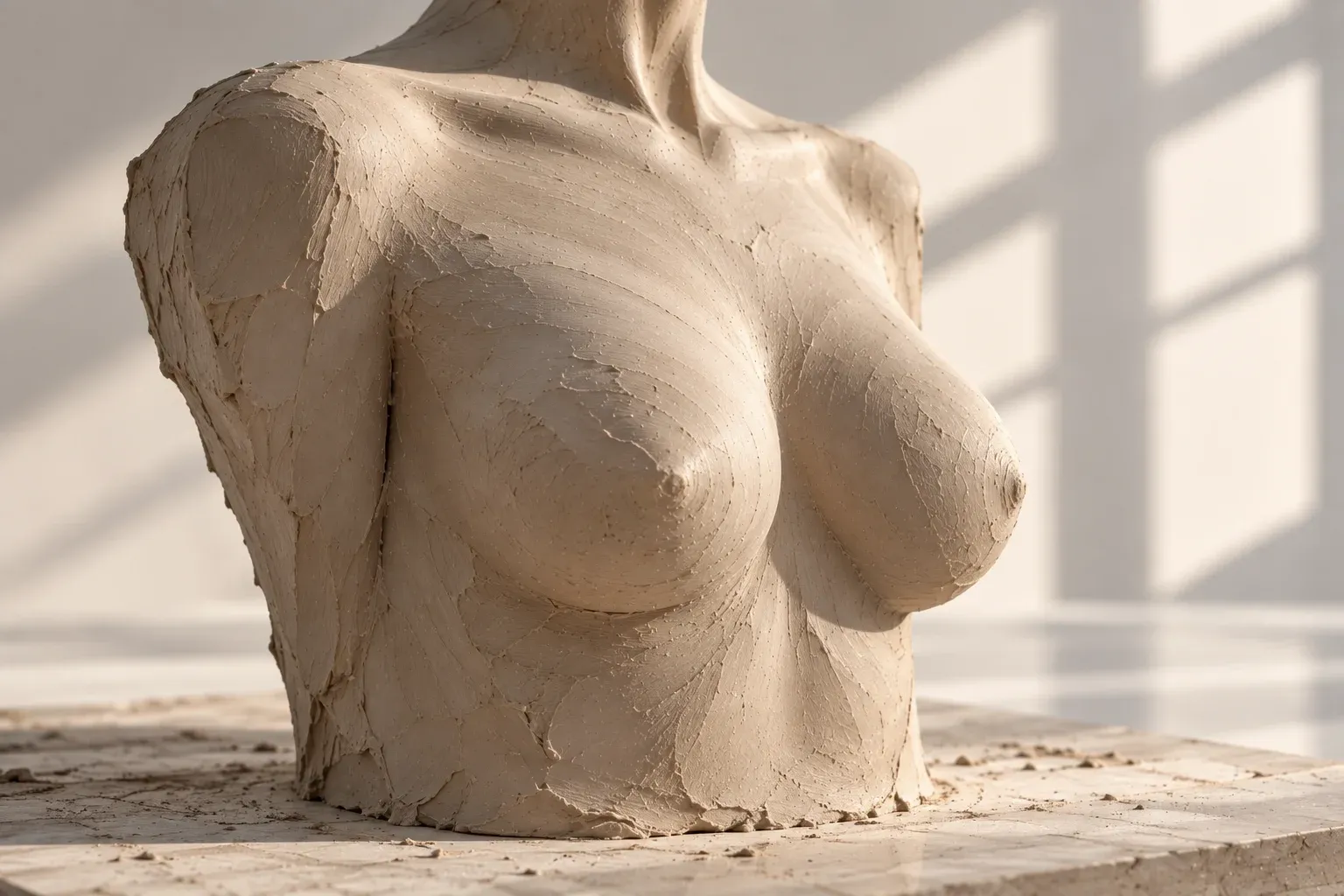
Different techniques are available today for breast augmentation. Alongside classic implant-based breast augmentation, depending on anatomy and treatment goal, Preservé™ Breast Augmentation, Mia Femtech™, or breast augmentation with fat transfer may also be considered. At Clinic Selnau in Zürich, planning therefore does not begin with a particular technique or implant size. It begins with the question of which change fits your body and your expectations.
Our Approach
Every breast is different. The chest, breast width, skin, existing glandular tissue, the inframammary fold, and nipple position form the anatomical basis of every breast augmentation. Differences between the two sides are also normal and are already taken into account during planning.
This is not, therefore, about reproducing a particular breast shape, or achieving a desired cup size as precisely as possible. Instead, we look at how much volume is already present, how the breast is distributed across the chest, and what change you would like. Some women wish for a more noticeable change. Others simply want a little more volume, or to restore the proportions their breast had before. The method is only chosen once these questions have been clarified.
Volume, Shape & Proportions
A breast augmentation changes more than breast volume alone. It can influence projection, upper breast contour, décolleté, and the relationship between the breast and the body.
A breast augmentation may be considered for concerns including:
- Naturally limited breast volume
- Volume loss after pregnancy or breastfeeding
- Changes following weight loss
- Asymmetric breast development
- Differing breast volumes
- A wish for stronger projection
- A wish for more fullness in the upper breast
- Restoring previous breast proportions
- A wish for a moderate change using the body's own tissue
- Correction of selected differences in shape or volume
Not every change to the breast, however, can be addressed by added volume alone. Where skin and breast tissue have descended significantly, or nipple position has changed, a breast lift may be more appropriate, or combined with a breast augmentation. For this reason, it is first assessed whether volume, excess skin, tissue position, or several of these factors are decisive for the desired change.
Planning & Analysis
A careful analysis forms the basis of every breast augmentation. During consultation, we assess the chest, breast width, existing breast tissue, skin quality, the inframammary fold, and nipple position. Existing asymmetries are also taken into account.
Together, we discuss which change you would like, and how significant it should be. This concerns not only volume, but also shape, projection, and the desired relationship to the rest of the body. For an implant-based breast augmentation, implant width, projection, shape and position are additionally considered.
Where Preservé™ Breast Augmentation, Mia Femtech™, or breast augmentation with fat transfer are being considered, we assess whether the anatomical requirements for the respective technique are met. At the same time, we assess whether the existing tissue position allows for a pure breast augmentation, or whether a breast lift may be additionally necessary.
On this basis, a treatment plan is developed that starts not from a preferred method, but from your body and the desired result.
The Procedure
There is no single breast augmentation for every woman. In a classic implant-based breast augmentation, an implant is placed through an individually planned approach. Position can be chosen differently depending on anatomy and existing tissue coverage.
Implants can be positioned above the chest muscle, or partially or fully beneath it. Dual-plane techniques, too, can be used depending on the starting point. What matters is not that one implant position is generally better. Existing tissue thickness, breast shape, muscle activity, implant size, and the desired contour together determine which position makes sense.
Alongside these established techniques, Preservé™ Breast Augmentation and Mia Femtech™ offer further implant-based concepts that follow a different surgical approach. A breast augmentation with fat transfer, by contrast, uses no breast implant at all, and follows a different principle again.
Classic Implant-Based Breast Augmentation
Implant-based breast augmentation offers a wide range of possibilities in terms of volume, projection and shape. The implant is selected according to breast width, existing tissue coverage, and the desired change. Volume in millilitres alone is not decisive. Two implants with the same volume can differ considerably in width and projection, and appear correspondingly different.
Implant position, too, is determined individually. Where tissue coverage is sufficient, a position above the chest muscle may be considered. In other situations, partial or full coverage by the chest muscle can be more appropriate. The surgical approach and implant position are planned according to individual anatomy. Which combination of implant, approach and position is suitable is decided individually for each breast.
Preservé™ Breast Augmentation
Preservé™ Breast Augmentation is an implant-based technique that places particular emphasis on a tissue-preserving surgical approach and preserving the natural structures of the breast. The concept differs from a conventional breast augmentation in the type of tissue dissection and implant placement. The aim is to place the implant in a controlled way while preserving existing tissue structures as much as possible.
Preservé™, however, is not automatically suitable for every breast or every desired change. Existing breast tissue, skin quality, breast shape and desired volume determine whether the anatomical conditions for this technique are met. Preservé™, too, is a breast augmentation with an implant. Implant-related risks and long-term changes therefore remain part of the consultation. What matters is not applying a particular technique, but assessing whether it suits the individual starting point.
Mia Femtech™
Mia Femtech™ also follows a tissue-preserving approach to breast augmentation. The technique is aimed in particular at women who wish for a comparatively moderate enlargement and whose anatomy is suited to this form of treatment. The focus is on a controlled change in breast volume, with a treatment concept specifically tailored to this.
Mia Femtech™, however, is not suitable for every desired breast size or every starting point. Existing tissue, breast shape, skin quality and the desired extent of change need to be considered. Where a more significant increase in volume, a more substantial change in shape, or a relevant lift is also needed, other surgical techniques can offer more possibilities. Here, too, the same principle applies: the technique follows the anatomy and the treatment goal.
Breast Augmentation with Fat Transfer
A breast augmentation with fat transfer allows an increase in volume without a breast implant. Fat tissue is harvested from suitable areas of the body through liposuction, processed, and then placed in small amounts into different tissue layers of the breast.
This technique is particularly suited to women who wish for a moderate increase in volume and who have sufficient suitable fat tissue available in other areas of the body. Fat can also be used to specifically correct certain contours or asymmetries.
Unlike an implant, however, fat transfer cannot achieve a comparable increase in volume in every situation. Some of the transplanted fat tissue is reabsorbed by the body. How much integrates permanently cannot be fully predicted. In some situations, further treatments may therefore be necessary. Fat that has integrated long-term behaves like the body's own fat tissue, and can change accordingly with significant weight fluctuations.
Implant, Preservé™, Mia or Fat Transfer?
The different techniques are not different quality levels. They offer different possibilities. A classic implant-based breast augmentation offers a wide range in terms of volume, shape and projection. Preservé™ Breast Augmentation and Mia Femtech™ follow specific implant-based treatment concepts and, where anatomy is suitable, can be considered for certain forms of tissue-preserving breast augmentation. A breast augmentation with fat transfer, by contrast, uses no implant, and is particularly suited to a moderate increase in volume or targeted contour correction.
None of these methods is inherently the best. What matters is the starting anatomy, existing tissue, desired volume, skin quality, and personal preferences. It is not the technique that determines the ideal breast augmentation. Your desired change and your anatomy determine which technique makes sense.
Breast Augmentation or Breast Lift?
Volume loss and descended breast tissue can look similar at first glance, but require different treatment approaches. Where mainly volume is missing, and the position of the breast and nipple is sufficiently stable, a breast augmentation alone may be appropriate. Where breast tissue and the nipple have descended significantly, or relevant excess skin is present, a breast lift can be the more suitable treatment.
A breast lift does not primarily add volume. Existing breast tissue is reshaped and lifted, excess skin is reduced, and nipple position can be adjusted according to the starting point. Where both volume loss and relevant descent are present, both techniques can be combined. In such an augmentation-mastopexy, the breast is lifted while volume is added at the same time. Depending on the starting point, implants or fat transfer may be considered for this. A larger implant choice, however, should not replace a necessary breast lift.
Additional volume can make a descended breast appear fuller, but does not automatically correct the position of breast tissue and nipple. An oversized implant can place additional weight on already burdened tissue where tissue quality is unsuitable. For this reason, another question comes before the choice of technique: is the breast primarily missing volume, position, or both? This distinction determines whether a breast augmentation, a breast lift, or a combination of both techniques makes sense.
Naturalness Is a Question of Proportion
A natural result cannot be defined by a particular implant size or technique. The same volume can look completely different on different bodies. The chest, shoulder width, waist, existing breast tissue and skin quality determine which volume fits naturally into the body's proportions.
Personal preferences differ as well. Some women wish for a change that is as unnoticeable as possible. Others deliberately want more projection, or a more pronounced décolleté. Both can be right, when planning matches the anatomy and the desired result. A successful breast augmentation therefore does not begin with a cup size. It begins with the proportions of the body.
Healing & Results
The healing phase depends on the chosen technique and the extent of the procedure. After an implant-based breast augmentation, swelling and a feeling of tightness are normal at first. The breast can initially appear firmer or higher, before the tissue and implant position stabilise over time. With Preservé™ and Mia Femtech™, too, individual healing depends on anatomy, the implant, and the procedure performed.
After a breast augmentation with fat transfer, swelling and bruising also occur at the areas where fat was harvested. The breast can initially appear fuller, as some of the transferred volume is reabsorbed over time. Where a breast augmentation is combined with a breast lift, the necessary reshaping of the breast also influences the healing process.
The final result therefore cannot be assessed immediately after the procedure. As healing progresses, shape and contours become more natural, and the breast increasingly fits into the body's proportions.
Implants & Long-Term Changes
Breast implants are medical devices and should not be considered a lifelong, unchanging solution. The breast continues to change after surgery as well. Pregnancies, weight fluctuations, skin ageing, and changes to your own breast tissue can influence shape and position over the years.
Implant-related changes, too, can occur long-term and may require further examinations or surgical procedures. These include, among others, changes in implant position, changes to the surrounding capsule, or other implant-related complications — situations addressed under Implant Exchange & Removal. These aspects are discussed regardless of whether a classic breast augmentation or a specific implant-based technique such as Preservé™ or Mia Femtech™ is chosen.
A breast augmentation is therefore not planned only for its immediate result. The long-term development of the breast is also part of the decision.
The aim is not the largest possible result, but one that suits your frame, your proportions, and how you want to look and feel.
Consultation
A breast augmentation begins with the question of what change you actually want. During your consultation at Clinic Selnau in Zürich, we assess breast shape, breast width, existing tissue, skin quality, the inframammary fold, and nipple position. At the same time, we consider the proportions of the chest and body.
We discuss what volume and shape you have in mind, and what possibilities your anatomy offers. On this basis, we compare the different treatment options. These can include a classic implant-based breast augmentation, Preservé™ Breast Augmentation, Mia Femtech™, or a breast augmentation with fat transfer. At the same time, we assess whether a pure increase in volume is sufficient, or whether a breast lift or a combined augmentation-mastopexy better addresses your existing anatomy.
We discuss openly the differences between the techniques, possible scars, implant positions, the expected healing process, and the limitations and risks of each treatment. The aim is not to apply a particular technique, or to create a predetermined breast shape. It is to choose the treatment that fits your anatomy, your expectations, and the proportions of your body that you want.