

Liposuction
Removing localised areas of excess fat to refine body contours and create more balanced proportions.
Fat tissue is distributed differently in every person.
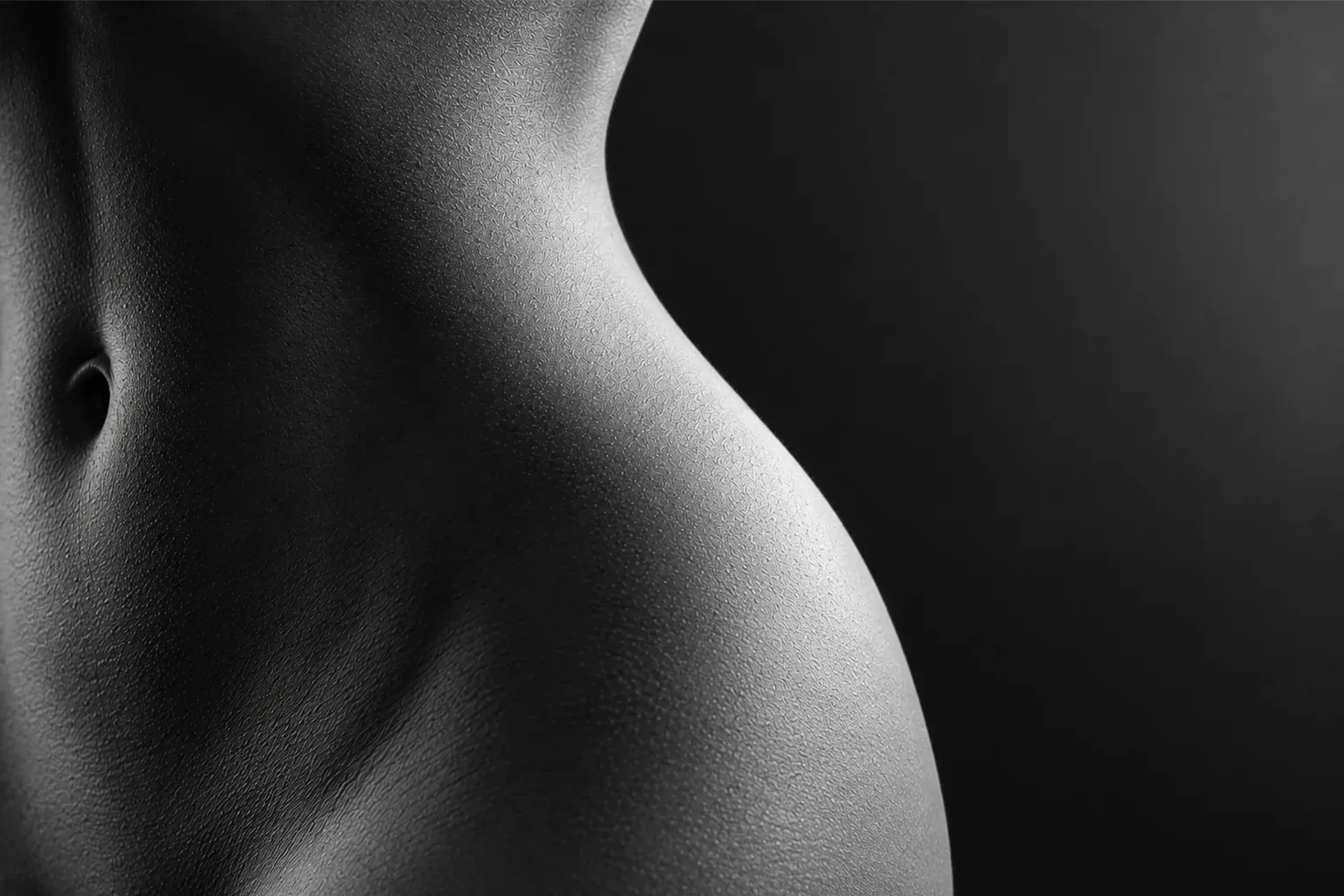
Genetic predisposition, hormones, age and individual body proportions influence where fat is preferentially stored. Some fat deposits persist even with a stable body weight, balanced diet and regular exercise.
Liposuction, also known as fat removal, allows such localised fat deposits to be reduced in a targeted way and the contours of individual body regions to be changed.
This is not about general weight reduction.
What matters is the relationship between individual body regions, and where localised fat tissue changes the natural contour.
At Clinic Selnau in Zürich, we therefore plan a liposuction not according to the amount of fat that can be removed. The focus is on the contour that should result from the treatment.
Our Approach
Liposuction is an operation of proportions.
The same fat volume can look completely different on different bodies. A small deposit at the waist, for example, can have a significant effect on the silhouette, while in another body region a larger volume reduction may be necessary to achieve a visible change.
For this reason, we do not consider only the individual problem area. We assess the transitions to adjacent body regions and take body build, fat distribution, skin quality and tissue elasticity into account.
Equally important is the question of what happens to the overlying skin after fat tissue is removed. With good skin elasticity, it can adapt to the changed contour. Where noticeable excess skin already exists, liposuction alone cannot achieve the desired tightening.
Treatment is therefore guided not only by where fat is present, but also by how skin and tissue can respond to volume reduction.
Fat, Skin & Body Contour
Liposuction is particularly suited to localised fat deposits.
Typical treatment areas can include:
- Abdomen
- Waist and flanks
- Hips
- Back
- Upper arms
- Inner and outer thighs
- Knees
- Chin and neck
- Other localised fat deposits
Which regions can meaningfully be treated depends on individual fat distribution and skin quality.
Liposuction can change body contours, but it cannot remove excess skin. This distinction is particularly important at the abdomen, upper arms and thighs. Where relevant excess skin exists alongside fat tissue there, an abdominoplasty, arm lift or thigh lift can be the more suitable treatment, or can be combined with liposuction.
Planning & Analysis
A careful analysis forms the basis of every liposuction.
During consultation, we assess fat distribution, skin quality and the contours of the affected body regions.
We do not consider the region in isolation. When treating the abdomen, for example, the waist and flanks are also considered. For the thighs, the transitions to the hip, knee and buttocks play a role. For the upper arms, we consider the entire contour between the shoulder and elbow.
Weight development and weight stability are also taken into account. Liposuction is not intended to reduce larger amounts of weight. It is particularly suited to localised fat deposits at a relatively stable overall body weight.
On this basis, we determine which regions are treated and how much volume can meaningfully be reduced without creating unnatural transitions or irregularities.
The Procedure
In a liposuction, fat tissue is loosened and suctioned through small skin incisions using fine cannulas.
Before the actual fat removal, the area to be treated is prepared according to the technique used. The fat is then removed in a controlled way from different tissue layers.
This is not about suctioning as much fat as possible. Overly aggressive reduction can promote unevenness, unnatural transitions, or a deterioration of skin contour.
What matters, therefore, is even contouring. The remaining fat layer needs to fit the skin, the underlying anatomy, and the adjacent body regions.
Which Regions Can Be Combined?
A disruptive body contour often involves more than a single region.
The abdomen and flanks, for example, together influence the shape of the waist. The hips and thighs together determine the transition to the buttocks.
For this reason, several neighbouring regions can be considered within one treatment concept. Which combination makes sense depends on the extent of the planned liposuction, the length of the operation, and the individual health situation.
The aim is not to treat as many regions as possible at once. What matters is selecting the areas that together enable the desired change in body contour.
Liposuction or Abdominoplasty?
At the abdomen, the distinction between fat tissue and excess skin is particularly important.
Where mainly a localised fat deposit is present and the skin has good elasticity, liposuction alone may be sufficient. Where excess or significantly lax skin is present, however, liposuction cannot remove it. Changes to the abdominal wall, too, cannot be corrected by liposuction.
In such situations, an abdominoplasty can be the more suitable treatment. Fat deposits and excess skin often exist at the same time. In this case, liposuction and abdominoplasty can be combined within a joint treatment concept.
It is not the amount of fat tissue that decides between liposuction and abdominoplasty. What matters is which anatomical structures are changing the abdominal contour.
Liposuction or Arm Lift?
At the upper arms, too, a distinction must be made between fat volume and excess skin.
With localised fat tissue and good skin elasticity, liposuction can refine the contour of the upper arms. Where the skin is significantly lax, or pronounced excess skin is present, however, removing fat alone may not be sufficient.
In such situations, an arm lift can be necessary to remove excess skin and reshape the contour. In some starting situations, both techniques are combined. Which treatment makes sense therefore depends on whether fat, skin, or both structures contribute to the visible change.
Liposuction or Thigh Lift?
The same principle applies to the thighs.
Localised fat deposits on the inner or outer thigh can be treated with liposuction, where the skin is sufficiently elastic. Following significant weight loss, or with pronounced loss of elasticity, excess skin can be the primary concern instead.
A thigh lift makes it possible to reduce this excess skin and reshape the contour of the thigh. An additional liposuction can make sense depending on fat distribution. Restrained planning is particularly important at the thighs, since skin quality and tissue distribution have a significant influence on the later contour.
Liposuction Following Weight Loss
Following significant weight loss, localised fat deposits can remain. Often, however, fat volume is no longer the primary concern, but excess skin.
In these situations, it must first be clarified whether a further reduction in volume can actually achieve the desired change. Where pronounced excess skin exists, lifting procedures within a more comprehensive body contouring concept can be more appropriate. Depending on the affected region, these can include an abdominoplasty, arm lift, or thigh lift.
Liposuction and lifting procedures are not competing techniques. They address different anatomical structures and can complement each other meaningfully.
Liposuction Following Pregnancy
Following pregnancy, fat distribution, skin and the abdominal wall can change.
Where mainly localised fat deposits exist, and the skin has retracted sufficiently, liposuction can make sense. Where excess skin or relevant changes to the abdominal wall exist, however, liposuction alone is often not sufficient.
In this case, an abdominoplasty can be the more suitable treatment, or can be combined with liposuction. Where changes to the breast are to be treated at the same time, a breast lift / mastopexy or breast augmentation can, depending on the starting point, form part of a more comprehensive treatment concept.
Whether several procedures can be combined is assessed individually, taking into account the extent of surgery and safety.
How Much Fat Can Be Removed?
The aim of a liposuction is not the maximum possible fat removal.
The amount that can meaningfully and safely be removed depends on the treated region, overall body constitution, skin quality, and the extent of the operation.
For the later contour, it is also essential that an even fat layer remains. Very aggressive liposuction can increase the risk of contour irregularities and, with insufficient skin elasticity, make existing excess skin more visible.
For this reason, the extent of fat removal is not planned by litres alone. A good liposuction does not remove as much as possible. It removes fat exactly where it is changing the proportions.
Skin Quality Plays a Role Too
The quality of the skin has a significant influence on the result of a liposuction.
After fat volume is removed, the overlying skin needs to adapt to the changed contour. With good elasticity, this adaptation can be significantly more pronounced. With thin, significantly stretched, or already lax skin, the capacity to retract is more limited.
This does not automatically mean that liposuction is not possible. It does, however, change expectations for the result and can mean that an additional lifting procedure makes more sense.
For this reason, assessing the skin is just as much a part of planning as assessing the fat tissue.
Contour, Not Weight
Liposuction is not a method for weight loss.
It changes the distribution of fat tissue locally, and with it, the contours of the body. The number on the scale is therefore not a meaningful measure of the result.
What matters is how the treated region relates to the rest of the body. The waist, hip, abdomen or thigh can appear differently proportioned through comparatively limited changes in local fat volume.
A successful liposuction, therefore, is not recognised by the amount of fat removed. What matters is the contour that remains.
Healing & Results
Swelling and bruising are normal at first after a liposuction.
The treated regions can feel firmer, uneven or swollen in the first few weeks. Compression garments can be part of aftercare, depending on the region and extent of treatment.
The contour changes gradually as swelling subsides and the tissue adapts. The early postoperative appearance therefore does not yet reflect the final result. Further development depends, among other things, on the treated region, the extent of the liposuction, skin quality, and individual healing response.
Long-Term Changes
In a liposuction, fat cells are permanently removed from the treated region. This does not mean, however, that body weight can no longer change after the operation.
The remaining fat cells can still enlarge with weight gain. Other body regions, too, continue to respond to changes in body weight.
A stable weight, therefore, supports the long-term stability of the proportions achieved. Skin and tissue also continue to change with age. Liposuction changes an existing body contour, but does not stop the body's natural changes.
Consultation
A liposuction begins with the question of what is actually causing the disruptive body contour.
During your consultation at Clinic Selnau in Zürich, we assess fat distribution, skin quality and tissue elasticity, as well as the transitions to adjacent body regions.
We discuss which areas concern you, and what change you would like.
On this basis, we assess whether liposuction alone makes sense, or whether excess skin requires an additional or alternative lifting procedure. At the abdomen, this can be an abdominoplasty; at the upper arms, an arm lift; and at the thighs, a thigh lift.
Where several body regions are affected, treatment can be planned as part of a more comprehensive body contouring concept.
We discuss openly what result can realistically be expected, how the healing phase unfolds, and what limitations and risks need to be considered.
The aim is not to remove as much fat as possible. It is to reduce, in a targeted way, those fat deposits that are changing the proportions, and to develop a more harmonious body contour from this.