

Dermal Fillers
Restoring volume, refining contours and balancing facial proportions with careful attention to individual anatomy and natural expression.
The face changes over time.
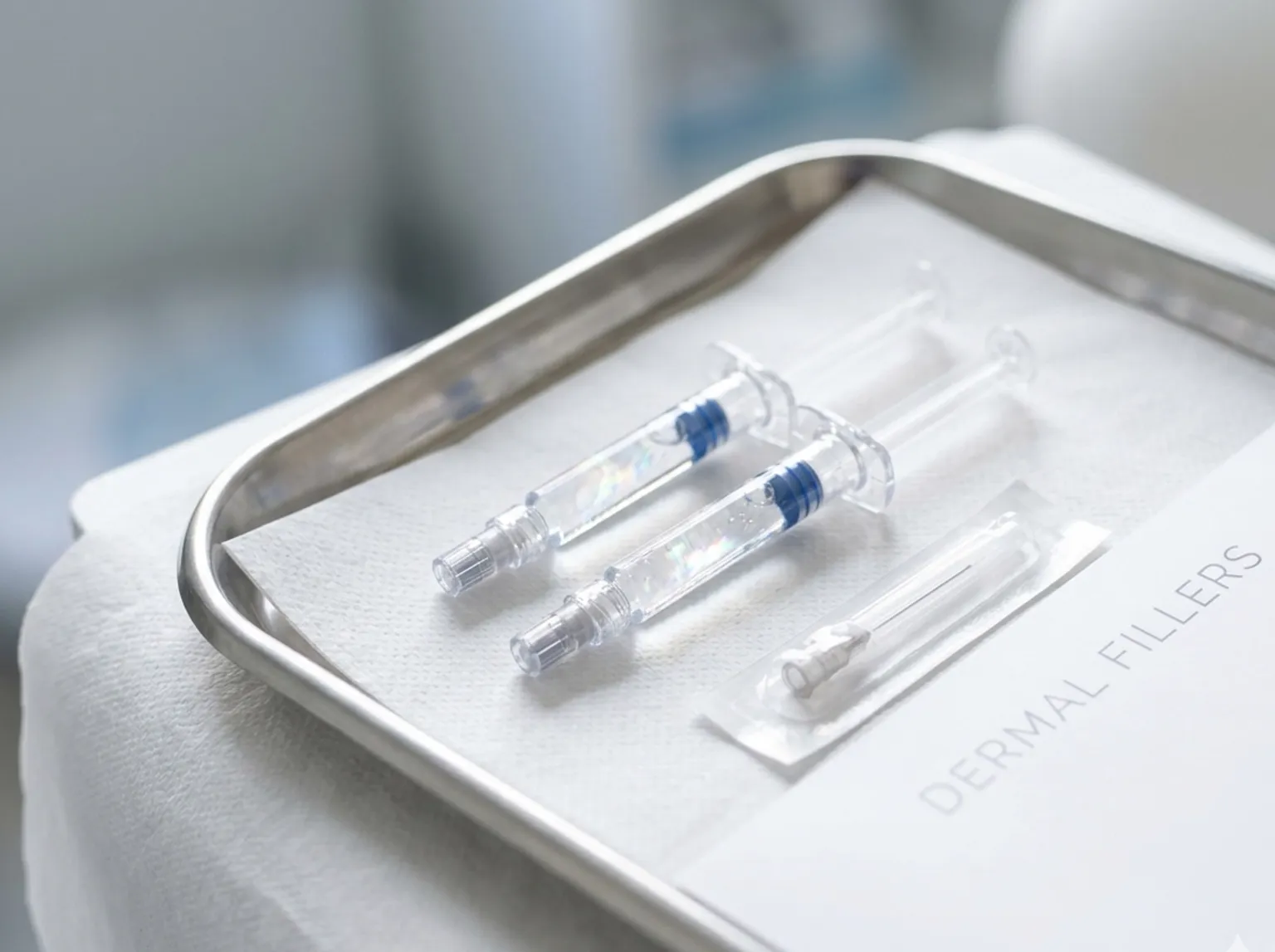
Bone structure, fat compartments, skin and connective tissue change in both volume and position. As a result, contours may become less defined, transitions can become more visible, and individual areas may lose structural support.
Dermal fillers allow us to selectively restore volume and support specific facial structures.
The aim is not to add as much volume as possible.
At Clinic Selnau in Zürich, we plan filler treatments according to individual facial anatomy and the structure actually responsible for the desired change.
Our Approach
A filler treatment does not begin with the question of how many millilitres should be used.
It begins with an analysis of the face.
We consider proportions, bone structure, soft tissue, volume distribution, skin quality, and the relationship between different facial regions.
Visible volume loss in one area does not automatically mean that filler should be placed directly into that area. Sometimes the underlying reason lies in an adjacent structure, or in a change in facial proportions.
The quality of a result is not determined by the amount of filler used. What matters is where volume is genuinely missing, and where deliberately adding none produces the better result.
What Are Dermal Fillers?
Dermal fillers are injectable materials used to restore volume, refine contours, or provide structural support.
Hyaluronic acid fillers are among the products most commonly used. Hyaluronic acid occurs naturally within the human body and has the ability to bind water.
Fillers differ in their physical properties depending on the product. A filler intended for structural contouring requires different characteristics from one used in a softer, more mobile area.
The amount of product is therefore only one consideration. Product selection, placement, and injection depth must also match the anatomical purpose.
Volume, Contour or Proportion?
Not every filler treatment has the same objective.
Sometimes the main concern is lost volume. In other situations, the aim may be to define an existing contour, or improve the relationship between different facial regions.
These distinctions are fundamental to treatment planning.
A good treatment therefore considers more than an isolated line or area. It considers the face as a whole.
A balanced result does not come from filling every hollow. It comes from finding the right relationship between volume, contour and proportion.
Which Areas Can Be Treated?
Depending on anatomy and treatment goals, dermal fillers may be used in areas including:
- Cheeks and midface
- Temples
- Lips
- Chin
- Jawline
- Selected lines and transitions
- Specific areas around the mouth and nose
Not every region is suitable for filler treatment in every patient. Anatomy, skin quality, and existing tissue structures determine whether an injection is appropriate.
Midface & Cheeks
The midface plays an important role in overall facial proportions.
With age, fat compartments, skin, and deeper structures can change. Volume may be lost or redistributed.
Targeted treatment can support selected areas of the midface and soften transitions. The aim is not to create the most prominent cheek possible. Added volume should integrate naturally with the existing facial anatomy.
Lips
Dermal fillers can be used to modify lip volume, contour, or proportion.
More volume does not automatically produce the most desirable or natural result. Lip shape, the relationship between upper and lower lip, projection, dentition, and the relationship to the rest of the face all influence treatment planning.
For some patients, subtle definition is the priority. For others, a change in volume may be desired.
If the primary issue is a long distance between the nose and upper lip, a lip lift & bullhorn lift addresses a fundamentally different anatomical concern.
A natural-looking lip is not defined by a particular number of millilitres. It is defined by proportions that belong to the face.
Chin & Jawline
The chin and lower jaw have a significant influence on the profile and proportions of the lower face.
Dermal fillers can be used in selected cases to define contours or alter projection and proportion.
However, it is important to distinguish between changes that can be achieved through the soft tissues and those primarily determined by bone structure. For more pronounced structural concerns, assessment for chin & jaw surgery may be more appropriate.
Fillers can visually influence the appearance of underlying bone structure, but they cannot anatomically change it.
Temples
The temples can lose volume with age.
This may make the transition between the forehead, temples, and midface appear more hollow. Carefully placed volume can soften this transition in selected cases.
However, the temporal region has complex vascular and tissue anatomy. Indication, product selection, and injection technique therefore require particular care.
Lines & Transitions
Not every line should be filled directly.
Some develop because of volume loss. Others are primarily caused by facial movement, skin quality, or changes in deeper structures.
The first step is therefore to understand why a line is visible.
For expression-related lines, botulinum toxin may be more appropriate. When skin quality is the main concern, biostimulators, medical cosmetics, or skin & laser treatments may address the underlying issue more effectively.
The visible line is not always the cause. Injecting directly into the line is therefore not automatically the right treatment.
Dermal Fillers or Botulinum Toxin?
Dermal fillers and botulinum toxin work in different ways.
Dermal fillers restore volume or support contours. Botulinum toxin selectively reduces the activity of specific muscles.
A dynamic frown line therefore requires a different approach from volume loss in the midface.
Both treatments can be combined when appropriately indicated. They do not replace one another.
Dermal Fillers or Biostimulators?
Biostimulators also follow a different treatment principle.
Dermal fillers can create an immediate change in volume and contour. Biostimulating treatments focus more strongly on tissue quality and regenerative processes over time.
The appropriate treatment depends on whether the primary concern is volume, contour, or the quality of the skin and underlying tissue.
In selected situations, both approaches can be combined.
Dermal Fillers or Fat Transfer?
Volume can also be restored using the patient's own fat.
With facial fat transfer, autologous fat is used to treat selected areas of the face.
The two approaches differ in planning, procedure, amount of volume, recovery, and long-term behaviour. Dermal fillers allow for highly targeted, non-surgical treatment with relatively little recovery time. Fat transfer may be particularly relevant when larger volume changes are required, or when treatment forms part of a surgical facial plan.
Neither method is inherently better. The individual anatomy and treatment goal determine which approach is more appropriate.
When Is More Filler Not the Answer?
Not every age-related change is caused by volume loss.
If tissue has descended significantly, or skin and soft-tissue laxity are the main concern, additional volume cannot correct the underlying problem.
In these situations, excessive filler can increasingly alter natural facial contours. Where tissue descent is more pronounced, a facelift or another surgical procedure may be the anatomically more appropriate treatment.
Volume can replace missing volume. It cannot indefinitely compensate for tissue that has changed position.
Natural Results & Dosage
Natural filler results are often associated with using the smallest possible amount.
This is too simplistic. Too little product may have no meaningful effect, while too much can alter facial proportions.
What matters is how much volume a particular region requires, and how that volume is distributed.
Sometimes one targeted treatment is sufficient. In other situations, a staged approach may be more appropriate. The result should belong to the face rather than primarily reveal that filler has been used.
Previous Treatments & Existing Filler
Many patients have had previous filler treatments.
Before further treatment, we consider which products were used, where they were injected, and how the tissues currently present.
Existing filler does not automatically need to be removed. However, if there is unwanted volume distribution, overcorrection, or another issue involving suitable hyaluronic acid fillers, dissolution with hyaluronidase may be considered in selected situations.
Only then is it decided whether, and when, further treatment is appropriate.
Safety & Vascular Anatomy
The face contains a complex network of blood vessels.
Individual vascular anatomy must therefore be considered with every filler injection. Rare but serious vascular complications are possible if filler material enters a blood vessel or compromises its blood supply.
For this reason, anatomical knowledge, clear indication, appropriate products, and careful injection technique are essential components of treatment.
Rare serious complications, including tissue injury or visual impairment, must also form part of informed consent.
Dermal fillers are therefore not simply a cosmetic service. They are a medical injectable treatment.
The Treatment
Before treatment, we analyse the face from different perspectives.
We discuss the desired change and identify the anatomical structure responsible for it. Product, quantity, injection depth, and treatment area are then determined.
The filler is precisely placed using fine needles or appropriate cannulas. Treatment time depends on the area and extent of treatment.
After Treatment
Temporary swelling, redness, tenderness, or small bruises may occur.
The immediate appearance does not always represent the final result. Areas such as the lips may initially appear considerably more swollen.
The treated tissues need time for swelling to settle before the result can be properly assessed. Specific aftercare recommendations are discussed according to the area treated.
How Long Do Dermal Fillers Last?
There is no single answer.
Longevity depends on the product, treatment area, tissue depth, metabolism, and individual anatomy.
Even within the same face, filler in different regions may remain visible or detectable for different periods of time.
Further treatment should therefore not be based solely on a fixed schedule. The important question is whether there is actually a renewed anatomical and aesthetic indication.
A Long-Term Treatment Concept
The face changes continuously.
Filler treatment should therefore not mean automatically adding more volume at every appointment. The current anatomy should be reassessed before each treatment.
Sometimes a touch-up is appropriate. Sometimes no further treatment is needed. And sometimes the anatomical starting situation has changed to the point where another approach is more appropriate.
A naturally balanced long-term result does not come from continuously adding volume. It comes from reassessing what the face actually needs each time.
Consultation
During a personal consultation at Clinic Selnau in Zürich, we assess your facial anatomy, proportions, and existing volume distribution.
We discuss the change you would like to achieve and whether dermal fillers are the appropriate treatment.
If muscle activity is the primary concern, botulinum toxin may be more suitable. If the focus is on skin and tissue quality or regenerative processes, biostimulators may be considered. For larger volume changes, facial fat transfer may be an alternative. Where tissue laxity is more pronounced, we assess whether a facelift or another surgical procedure would be anatomically more appropriate.
We discuss product selection, treatment extent, expected swelling, longevity, risks, and limitations.
The goal is not to add as much volume as possible. It is to provide support precisely where it contributes to balanced facial proportions.