

Facial Feminization & Masculinization
Refining facial proportions and contours to enhance feminine or masculine characteristics while respecting individual anatomy, identity and overall facial harmony.
Refining facial proportions and contours to enhance feminine or masculine characteristics while respecting individual anatomy, identity and overall facial harmony.
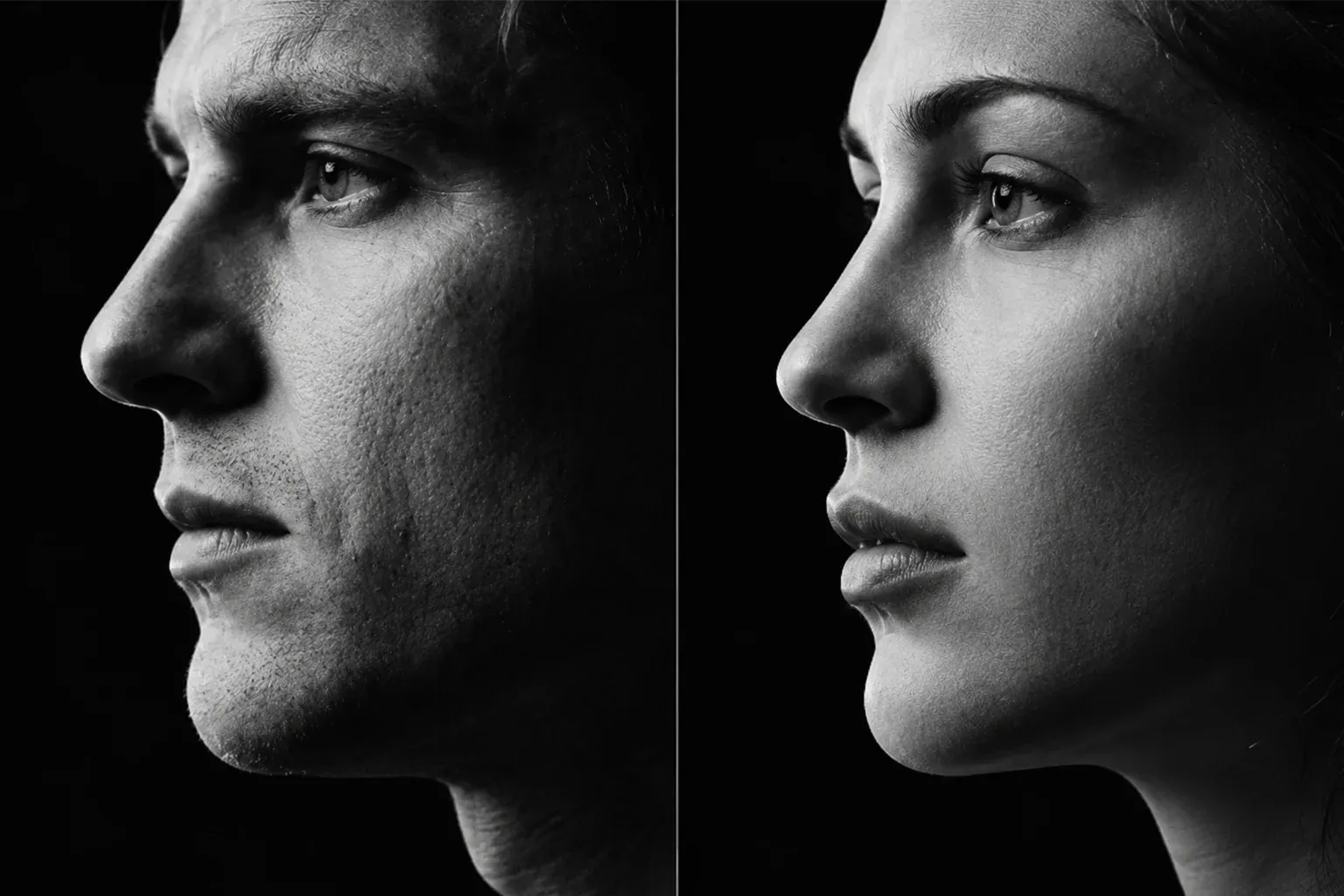
Whether a face is perceived as more feminine or more masculine does not depend on a single feature. The forehead, brow region, nose, cheeks, lips, chin and jaw exist in a complex relationship to one another and together shape the overall impression.
Facial feminization and facial masculinization are therefore not single operations. They encompass different surgical and non-surgical options that are put together individually, depending on anatomy and personal treatment goals.
This is not about conforming to a standardised feminine or masculine ideal.
The aim, rather, is to change, in a targeted way, those features that are decisive for how you wish your own face to be perceived, while your personal identity and characteristic features are preserved.
At Clinic Selnau in Zürich, we therefore understand facial feminization and masculinization as an individual treatment concept that can look different for every person.
Our Approach
Every face has its own proportions.
Bone structure, soft tissue, fat distribution, skin, nose, lips and jaw together determine how a face is perceived.
At the same time, there is no single feature that makes a face definitively feminine or masculine.
For this reason, planning does not begin with a fixed list of procedures.
We first consider the face as a whole and discuss which features you yourself experience as fitting, which you would like to change, and which should be preserved for your personal expression.
For some people, a single region is the main concern. For others, the desired result emerges only through the interplay of several smaller changes.
What matters is not changing as many features as possible. It is to identify the structures that are actually relevant to the desired change.
Proportions, Contours & Expression
Feminine and masculine facial characteristics result from the interplay of various anatomical features.
These include, among others:
- The shape and projection of the forehead
- The position and arch of the brows
- The shape and proportions of the nose
- Cheek contours and the midface
- The shape and visibility of the lips
- The projection and width of the chin
- The width and contour of the lower jaw
- The relationship between the upper, middle and lower thirds of the face
- The distribution of volume and soft tissue
- The transitions between the face and neck
None of these features is assessed as feminine or masculine in isolation.
A wider jaw contour, for example, can appear harmonious in one face and dominate the lower facial proportions more strongly in another. Likewise, the effect of the forehead, nose or lips always depends on the surrounding structures.
For this reason, the focus is not on a single anatomical feature, but on its effect within the face as a whole.
Planning & Analysis
A careful analysis of the entire face forms the basis of treatment.
During consultation, we examine your face from different perspectives and assess the proportions of the forehead, eye area, nose, cheeks, lips, chin and jaw.
We consider both bony structures and the skin, fat tissue and other soft tissue.
Standardised photography supports this analysis and helps us discuss individual proportions and possible changes together.
Your personal treatment goal, however, is especially important. Not everyone wishes for a comprehensive feminization or masculinization of the entire face. Sometimes it is simply about enhancing certain features, or reducing others.
On this basis, an individual treatment plan is developed.
Which Areas Can Be Treated?
Facial feminization and masculinization can involve different regions of the face. Which of these make sense depends on existing anatomy and the desired result.
Forehead & Brows
Forehead shape and brow position influence how the upper face is perceived. Depending on the starting point, changes to forehead contour or brow position may be appropriate. A brow lift or forehead lift can form part of a more comprehensive treatment concept.
Nose
The nose occupies a central position in the face and significantly influences both the profile and the frontal view. A rhinoplasty can change shape, projection, width or contours, and can be tailored specifically to the desired facial proportions. What matters is not creating a fundamentally feminine or masculine nose. The nose should harmonise with the forehead, cheeks, lips and chin.
Cheeks & Midface
The shape and projection of the cheeks influence the contours of the midface. Depending on the treatment goal, volume and transitions can be changed. Different methods may be appropriate for this, including a fat transfer to the face or selected non-surgical treatments.
Lips
Lip shape, volume and the relationship between the nose and upper lip also influence how the face is perceived. Depending on anatomy, dermal fillers, or for corresponding proportions a lip lift & bullhorn lift, can represent different options.
Chin & Jaw
The chin and lower jaw shape the lower face particularly strongly. As part of chin & jawline surgery, these structures can be more strongly defined, reduced, or changed in their proportions, depending on the starting point.
Feminization
In facial feminization, features that are perceived as more masculine in the individual face can be changed in a targeted way.
Which changes make sense, however, differs considerably from person to person.
Depending on anatomy, a change to the forehead, brow region, nose, chin or jaw may be the primary focus. In other faces, even smaller changes to soft tissue or proportions can have a significant effect on the overall impression.
Feminization therefore does not automatically mean maximally reducing all anatomical differences. Overly extensive changes can cause characteristic facial features to be lost, or create new inconsistencies between individual regions.
The aim is a balanced change to those features that are decisive for the desired perception.
Masculinization
Facial masculinization, too, follows no fixed treatment scheme.
Depending on the starting point, more strongly defined contours of the chin and jaw, changes to the nose, or a different distribution of volume and projection in the face may be appropriate.
This is not about making individual features as large, wide or angular as possible. What matters is their relationship to one another.
A more strongly projected chin, for example, can change the profile, while a more defined jawline influences the contours of the lower face. Whether such a change appears harmonious, however, depends on the nose, cheeks, forehead and the remaining facial proportions.
In masculinization, too, the face as a whole remains the central focus.
Surgical or Non-Surgical?
Not every desired change requires surgery.
Smaller changes to volume or contours can, in suitable situations, be achieved with dermal fillers, botulinum toxin, or a fat transfer to the face.
Where the underlying bone structure or more pronounced anatomical proportions need to be changed, surgical procedures may be necessary.
Both approaches pursue different goals. Non-surgical treatments can complement contours or change volume. They cannot, however, replace a necessary change to bony structures.
Conversely, surgery is not automatically appropriate where the desired result can be achieved with a smaller treatment.
The choice is therefore guided by anatomy, treatment goal, and the desired extent of change.
One Procedure or Several Steps?
Facial feminization or masculinization does not need to take place in a single operation.
Where several regions are to be treated, we first assess which procedures can meaningfully be combined, and which are better performed in separate steps.
The extent of surgery, healing time, and the mutual effect of individual changes all play a role here.
Sometimes it can make sense to first treat a particularly defining region and allow the result to settle before planning further changes.
The face changes as a whole with every procedure. A new nasal shape, for example, can influence the perception of the chin, while a change to the jaw can make the proportions of the midface appear different.
For this reason, the sequence of treatments is planned as carefully as the individual procedures themselves.
Identity, Not Ideal
There is no single feminine face, and no single masculine face.
Faces vary considerably within each gender in shape, proportion and expression. Treatment should therefore never attempt to reproduce a predetermined ideal.
The starting point is always the face as it exists.
We consider which features are characteristic of your identity, which you would like to preserve, and which you would like to change in a targeted way.
Sometimes only a few changes are enough to shift the perception of the entire face. More procedures, therefore, do not automatically mean a better or more coherent result.
Facial feminization and masculinization do not mean creating a different face. They mean making the features you identify with more visible.
Healing & Results
The healing phase depends significantly on which treatments are performed.
After soft tissue procedures, swelling and bruising can initially be the main concern. Where bony structures are changed, swelling can be more pronounced and take longer before the final contours become visible.
Where several regions are treated at the same time, healing processes can overlap.
For this reason, the early result should not be judged as the final facial proportion.
As healing progresses, swelling subsides, tissue stabilises, and the new contours become clearer. Depending on the extent of treatment, this process can take several months.
The aim is not a standardised feminine or masculine appearance.
The result should fit naturally into your own face and highlight the desired features, without losing your personal expression.
Consultation
Facial feminization and masculinization begin with an in-depth conversation about your personal goals.
During your consultation at Clinic Selnau in Zürich, we consider your face as a whole. We analyse the forehead, eye area, nose, cheeks, lips, chin and jaw, as well as their relationship to one another.
This is not about identifying as many potential changes as possible.
We want to understand which features matter to you, which you would like to change, and which should absolutely be preserved.
On this basis, we discuss which surgical or non-surgical options are appropriate, and whether a single treatment or a step-by-step concept makes more sense.
We explain openly which changes are realistically achievable, which procedures can be combined, how the respective healing phase unfolds, and what limitations and risks need to be considered.
The aim is not a predetermined ideal.
It is to develop a treatment concept that respects your anatomy and highlights the features that correspond to your own understanding of your face.