

AESTHETIC MEDICINE · CLINIC SELNAU
The AI Face: When the face you want is no longer your own.
Filters, face apps and artificial intelligence are increasingly changing the way we imagine ourselves. But what works on a screen does not automatically work for a real face. Why modern aesthetics, to us, is not about following an ideal — but preserving individuality.
It's a moment that comes up in consultations more and more often: a patient opens her phone and shows a picture — not a photo of someone recognizable, but a face that never actually existed. Generated by an app, smoothed by a filter, refined by an AI model. A face that could be hers, but isn't. The question hanging in the room afterward is rarely spoken aloud, but it's there: can you make me look like that?
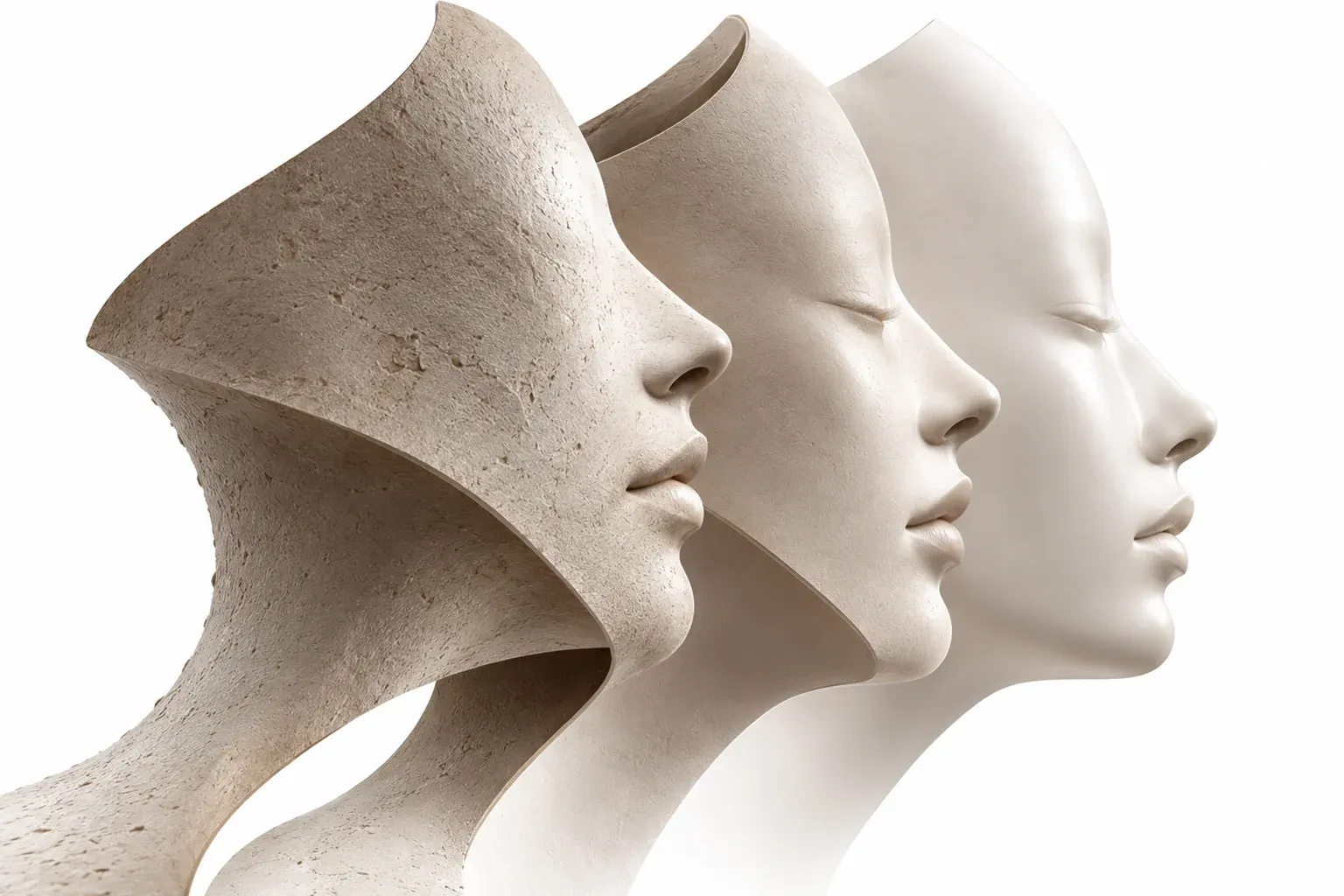
This question is new — not because people wanting to look different is new, that's always been true, but because the reference image itself is no longer tied to a real person. For decades, people's wishes were shaped by existing faces — actresses, models, acquaintances. Today, the reference image can be a face no photographer ever captured, because it never stood in front of a camera. It was computed.
From Filters to Generated Faces: A Short History of Self-Perception
The development that led to this moment happened in stages. First came filters that altered real faces in real time — smoother skin, larger eyes, narrower noses, subtle enough that many users, after a while, barely noticed they were looking at an altered version of themselves. Research into how people perceive their own faces suggests that repeated exposure to a filtered self-image can gradually shift expectations for the unfiltered original — a face seen slightly optimized every day can, over time, start to feel less familiar than it should.
Face-swap apps went a step further: rather than showing one's own, slightly altered face, they placed that face into entirely different contexts, often with stylized, retouched, or idealized features. The latest stage is generative AI models, trained on millions of images, capable of producing entirely new faces that never existed in this form — statistically optimized for symmetry, certain proportions, and features currently considered attractive.
The Difference Between a Computed Face and a Grown One
An AI-generated face and a human face differ more fundamentally than they might appear to at first glance. A human face is the product of genetics, growth, bone structure, individual development, and the marks of a life lived — it doesn't follow a statistical optimization function, but a biological logic, in which nose, jaw, eyes, and cheeks stand in a grown, individual relationship to one another.
A face generated by an AI model follows a different logic: at its core, it's a statistical average of certain features judged attractive, often drawn from training data that already contains filtered or retouched images. Such a face doesn't exist on a skull. It follows no growth history, and it doesn't have to harmonize with a chin, a forehead, or a neckline that actually exist. When a feature is isolated from such an image — a particular nose, a particular jaw angle — and transferred onto a real face, the result isn't automatically the one seen in the picture. What emerges instead is a new relationship between that feature and the rest of the unchanged anatomy — an outcome that's hard to predict structurally without looking at the underlying individual anatomy.
Why Beauty Ideals Are Increasingly Converging
One effect that comes with generated and heavily filtered reference images is a certain homogenization of what currently counts as attractive. When training data for filters and AI models statistically favor certain features — a particular nose shape, a particular jaw-to-cheekbone ratio, a particular eye shape — the images produced from that data tend to converge toward one another, regardless of the original face of the person using the filter.
This effect can also be observed independently of artificial intelligence — trends in aesthetics have always existed, and not every trend is inherently a problem. The real risk arises only when a trend becomes a medical target: just because a particular nose shape, lip shape, or jawline is currently seen often doesn't mean it suits every face. A medical procedure lasts considerably longer than a social media trend — that difference in timescale shouldn't be underestimated in any consultation.
Why the Same Nose, Lips, or Jawline Don't Suit Everyone
A central reason a feature that looks good on a screen appears different on a real face lies in the nature of proportion itself. A facial feature never functions in isolation — its effect comes from its relationship to everything around it: the distance between the eyes, chin projection, forehead height, skin thickness, bone structure. A nose shape that looks balanced on one face can look out of place on another face with different proportions, even if the nose itself were identically shaped — a relationship that already holds true for real reference photos, and becomes even more pronounced with a computed image that has no basis in real anatomy at all.
The same logic applies to lips, jawlines, and practically every other facial feature. Wanting to borrow a particular feature is rarely the wrong impulse — but transferring that feature onto a different face requires adapting it to the existing, individual anatomy, not copying it identically.
What 3D Simulations Can Show — and What They Can't
Consultations increasingly make use of digital simulations to talk through a possible change: how much hump reduction feels right, how far a tip should be lifted, how a change in projection would affect the profile. A simulation can make questions like these visible and create a shared language between patient and physician where words alone often fall short.
It remains a simulation, though, not a promise. A simulation is made of pixels; a face is made of living tissue — skin quality, scarring, swelling, and individual biological response can't be fully predicted digitally. A simulation, then, should show a direction, not guarantee an exact outcome.
What Role Artificial Intelligence Can Play in Treatment Planning Itself
Beyond reference images, artificial intelligence is increasingly discussed as a tool within aesthetic medicine itself — supporting image analysis, documentation, or visualizing possible results. That can be valuable, but it has a clear limit: analysis isn't the same as a decision. An algorithm can recognize patterns in a face, but it doesn't automatically know a patient's personal motivation, her expectations, or what a particular feature means to her identity — and it can't decide, on its own, whether a medically possible change is actually a sensible one. Technology can support a consultation. It shouldn't replace individual medical judgment.
When a Legitimate Concern Turns Into a Search for the Next Flaw
A pattern that occasionally becomes visible in consultation deserves particular attention: after a successful treatment, focus sometimes shifts to the next feature. The nose has been corrected — suddenly the chin looks bothersome. The lips have been treated — now the cheeks seem too flat. This doesn't automatically mean a further treatment would be wrong. But it's worth pausing at that point and asking whether something is still being treated that genuinely bothers the patient — or whether the search has shifted to something that simply could be optimized. These two situations aren't the same, and recognizing the difference between them is one of the more responsible tasks of a consultation.
This is exactly why saying no belongs to aesthetic medicine — not as its opposite, but as part of good practice. Sometimes a desired result doesn't suit the existing anatomy. Sometimes a further change would disturb an already harmonious face rather than improve it. And sometimes the most sensible answer to a wish is to change nothing, for now.
What "Natural" Means in This Context
Naturalness is often misunderstood in aesthetic medicine — independent of AI-generated images too, as discussed in more detail elsewhere in this series. The term doesn't necessarily mean a change has to be small or restrained: a substantial rhinoplasty can look natural; a facelift can make a significant difference and still not look operated.
In the context of computed reference images, though, this idea takes on an additional dimension. An AI-generated or heavily filtered face almost always shows flawless skin, symmetrical features, and a surface free of the small irregularities that make up a real face — and that can create the impression that "natural" means flawless. In reality, it's closer to the opposite: naturalness doesn't come from approaching mathematical perfection as closely as possible. It comes from a change belonging to a person's existing anatomy and identity — pores, slight asymmetries, and individual features included, not in spite of them.
The Real Question: Approach an Ideal, or Preserve Identity?
Behind the growing use of generated reference images lies a deeper question that goes well beyond technique or procedure: should aesthetic medicine help someone approach a generic, statistically computed ideal — or help them preserve and refine their own, grown identity?
These two goals sound similar at first but lead to fundamentally different outcomes. Approaching a generic ideal tends to mean reducing individual features — the slight asymmetries, characteristic proportions, and personal quirks that make a face recognizably this particular face. Preserving and refining one's own identity, by contrast, means working with those individual features rather than smoothing them away.
There's no simple, universal answer to which goal is right — these preferences deserve respect, not judgment from outside. What can be said with more confidence is this: a result that follows the individual anatomy tends to age more coherently than one worked against it, because it continues to exist in natural relationship with the rest of the anatomy, which keeps changing too.
Conclusion
Filters, face-swap apps, and generative AI models have changed what people orient themselves by when thinking about changing their appearance — from the photo of a real person to an image with no basis in real anatomy at all. This shift is neither good nor bad in itself, but it calls for a more deliberate understanding of what a reference image can and can't show: a direction, not a template. The task of aesthetic medicine remains the same as it always was — not to bring people closer to an ideal, but to understand their individual anatomy and weigh changes carefully enough that identity is preserved where it should be. In a world of increasingly perfect images, that may be the truly modern form of aesthetics: not looking more perfect — but continuing to look like yourself.
The same question of naturalness comes up with surgical procedures too — read more in our articles "Why Do Some Operated Noses Look Natural — While Others Don't?" and "Why Do Some Facelifts Look Operated — While Others Don't?"
To learn more about our approach, visit our About Clinic Selnau page, or reach out to arrange a private consultation.
Frequently Asked Questions
Why do many generated or heavily filtered faces look similar to one another?
Because filters and AI models are built on training data that statistically favors certain features. The images produced from that data tend to converge, regardless of the individual starting face.
Can a feature from an AI-generated image be transferred directly onto my own face?
Not without adjustment. A feature always functions in relation to the surrounding proportions. Transferred unchanged, it can produce a different, often less coherent result than the one seen in the reference image.
Can a 3D simulation predict the exact result of a treatment?
No. A simulation can visualize a possible direction and make communication easier. The actual result is shaped by anatomy, tissue, healing, and individual biological factors that can't be fully modeled digitally.
Can artificial intelligence decide which treatment suits a particular face?
AI can support analysis and visualization, but it can't make a medical decision on its own. That requires individual medical judgment, weighing expectations, risks, and personal motivation.
When should a further aesthetic treatment be advised against?
Among other situations: when the desired result isn't anatomically achievable in a sensible way, when focus has shifted from an actual concern toward an ongoing search for smaller and smaller details, or when a further change would likely disturb an already harmonious result rather than improve it.