

FACE · DR. MED. MARKUS HANDLE
Why do some facelifts look operated — while others don't?
A younger-looking face is not simply a tighter face. Proportions, volume and the natural position of the tissues matter just as much as the skin itself. A good facelift should make you look refreshed — without changing your expression or identity.
A facelift is rarely judged by whether it happened at all. It's judged by whether anyone can tell. A successful result leaves a face looking rested and refreshed, without anyone quite able to say what changed. An unsuccessful one often shows itself at first glance — in a particular kind of tension, in proportions that no longer match the rest of the face, in details that have less to do with the tightening itself than with the execution around it.
The difference rarely comes down to whether enough was tightened. It usually comes down to how and where that tightening happened — and whether the individual proportions and original expression of a face were respected in the process.
Why Too Much Tension Changes a Face Rather Than Refreshing It
The most obvious reason for a visibly operated look is excessive tension on the skin. When most of the lifting effect is generated through the skin itself, rather than the deeper tissue layers, that tension has to show up somewhere — usually around the eyes, cheeks, or mouth.
The result is a face that looks smoother but loses some of its original expression in the process. The corners of the eyes can shift, the corners of the mouth can appear pulled outward, and the natural mobility of the facial muscles can seem restricted. These are exactly the details that other people — even without any medical knowledge — unconsciously register as "operated," even if they couldn't say why.
Techniques that work primarily at deeper tissue levels, letting the skin lie over the result with comparatively little tension, tend to avoid this problem more reliably — not because a particular technique automatically guarantees better results, but because the physics of tension distribution differ when deeper structures carry part of the load.
Why the Direction of Tightening Matters as Much as Its Extent
A face doesn't age uniformly in one direction, and a lift shouldn't tighten uniformly in one direction either. When tissue is simply pulled backward or upward regardless of its original, individual direction of descent, the resulting contours can look tighter without looking more coherent — including at the transition between the lower face and the neck, whose anatomical relationship is discussed in more detail elsewhere in this series.
A telltale sign of this is an unnaturally high-positioned cheek that no longer matches the rest of the facial proportions, or a cheekbone area that appears overly emphasized relative to the lower face. This kind of disharmony doesn't come from too little tightening — it comes from tightening that didn't follow the individual anatomy. A natural result respects where particular tissue can reasonably be returned to anatomically, not where it's easiest to pull it.
Can a Facelift Change Too Much?
Yes. More tightening doesn't automatically mean more rejuvenation. A face draws its character from natural transitions, volume, and movement — trying to eliminate every wrinkle, every small asymmetry, and every sign of age entirely tends to work against naturalness rather than for it.
A 60-year-old face doesn't need to look like a 35-year-old face after a facelift. It shouldn't look like one, either. The goal is to reverse certain changes accumulated over the years and restore contours — not to force the face into a different age or a different identity. Restraint is sometimes just as important as surgical precision.
Does a Natural Result Mean You Can Barely See a Difference?
No — naturalness and a clearly visible difference aren't mutually exclusive. A blurred jawline can become clearly defined again, descended tissue can be repositioned, pronounced excess skin in the neck can be substantially improved. The difference can be significant and the result can still look natural.
Naturalness doesn't mean as little as possible was changed. It means the result looks plausible — that the face doesn't tell the story of an operation, but instead looks as though it had simply reverted, on its own, to a fresher version of itself.
Why Volume Matters at Least as Much as Tightening
A younger-looking face isn't simply a tighter face. Aging affects not only the position of tissue but also its volume — certain areas lose fullness while tissue accumulates elsewhere. An operation focused exclusively on tightening, without accounting for this shift in volume, can leave a face looking flatter or more depleted rather than rejuvenated.
This shows up often around the temples and upper cheek, where volume loss is particularly visible. If this area is only tightened without compensating for missing volume, the result can, somewhat paradoxically, look older rather than younger — tight skin over hollowed contours reveals the underlying bone structure more starkly instead of softening it. For this reason, a facelift is often sensibly combined with targeted volume correction, such as fat grafting, rather than relying on tissue repositioning alone.
Why Too Much Filler Before a Facelift Can Become a Problem
Many people spend years trying to offset facial changes with non-surgical treatments — and that can work well for a long time. Fillers can add volume and improve certain contours. But once tissue increasingly descends, that process can't be indefinitely compensated for with more volume.
If more and more filler is used to offset a lost jawline or descended cheeks, a face can eventually look fuller or heavier without actually looking younger. That doesn't make filler inherently problematic — it simply shows that every treatment has its limits. Volume should address volume loss. It shouldn't be asked to conceal tissue descent that actually needs a structural solution.
What Scars, Hairline, and Ears Reveal About the Care Taken in an Operation
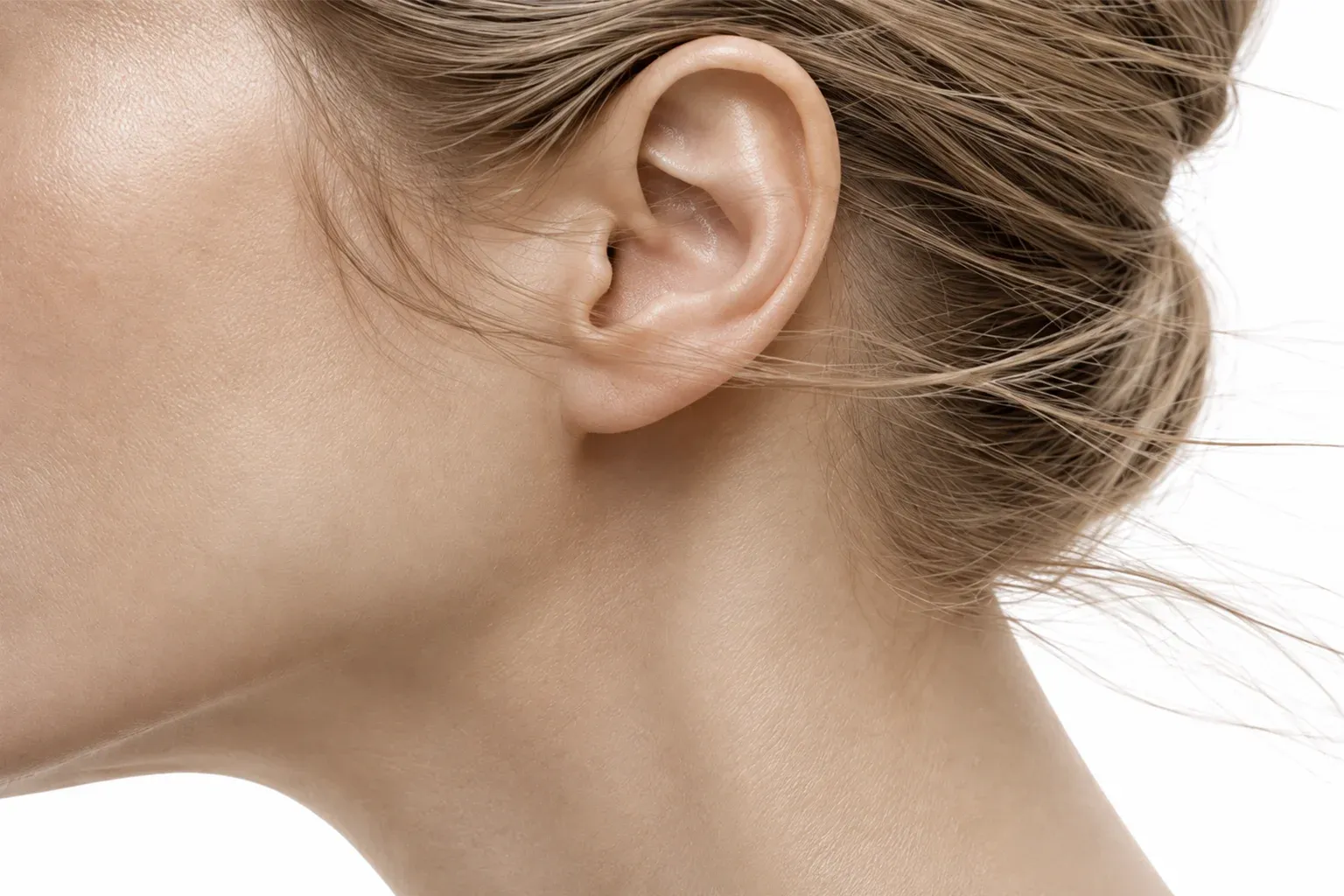
An often-underestimated detail lies in the small but telling signs around incision placement. A carelessly planned or shifted hairline, an earlobe visibly pulled forward or upward, or scars that don't follow natural skin creases are among the most common features that give a facelift away — often more clearly than the tightening of the face itself.
These details usually don't stem from the fundamental choice of surgical technique, but from the care taken in incision placement and in repositioning the skin and ear at the end of the operation. A forward-pulled earlobe, for instance, typically results when too much skin tension has to be absorbed directly at the ear — another argument for why tension should be distributed across deeper tissue layers wherever possible, rather than concentrated at single points like the ear.
Does a Good Facelift Need to Be Symmetrical?
A good result should look balanced — that isn't the same as mathematical symmetry. No face is perfectly symmetrical before surgery: eyes, brows, cheeks, jaw, and even the two halves of the face differ in practically everyone. A facelift doesn't make these differences disappear entirely. Some asymmetries can be improved; others remain visible or appear differently pronounced during healing.
Naturalness, then, doesn't mean perfection. A completely symmetrical, completely smooth face would probably not look more natural — it would look less human.
Why a Younger-Looking Face Isn't the Same as a Different Face
A common misconception holds that a good facelift result should eliminate as many signs of aging as possible. In practice, the opposite is often true: a face that loses every wrinkle, every asymmetry, and every individual quirk rarely looks younger — it looks unfamiliar.
Certain features of a face aren't signs of aging at all, but part of its individual identity — a particular eye shape, a characteristic cheek contour, a slight asymmetry that has always defined that face. If these features are altered in pursuit of the most complete possible tightening, a person can end up looking smoother but less like themselves. Friends and family often notice this before they can name it — the impression is less "this person looks younger" than "something about this person is different."
Why a Facelift Is Planned Differently for Men
The basic principles of facial aging are similar for men and women, but the aesthetic planning differs. Male faces often have different proportions, different hair distribution, and a beard line that has to be factored into incision placement — a scar that falls unobtrusively into the hairline on a woman can remain visible on a man with short or receding hair.
Changing certain contours too aggressively can also affect characteristically male facial features, such as a stronger jawline or a less prominent mid-face. As with any facelift, the principle holds: no standardized rejuvenation concept, but individual anatomy as the starting point — for men just as much as for women.
Conclusion
Whether a facelift looks operated rarely depends on whether enough was changed. It depends on how the tension was distributed, whether the direction of tissue movement followed the individual anatomy, whether volume loss was addressed rather than masked with excessive filler, how carefully scars, hairline, and ears were handled, and whether a face's individual features — asymmetries included — were preserved rather than smoothed toward a generic ideal. A younger-looking face isn't simply a tighter face — and a good facelift result should, ideally, not be recognizable as a facelift at all, only as a fresher, more rested version of the same person.
To learn more about our approach, visit our Facelift page, or reach out to arrange a private consultation with Dr. med. Markus Handle.
Frequently Asked Questions
Why can you tell right away that some facelifts were done?
Usually because of excessive skin tension, a lifting direction that doesn't follow the individual pattern of tissue descent, unaddressed volume loss, or noticeable details like a pulled earlobe or a shifted hairline.
Does a natural result mean less was changed?
No. Substantial changes to the jawline, face, and neck can still look natural. What matters isn't the extent of the change, but whether it follows the individual anatomy and looks plausible.
Why can a facelift make a face look older instead of younger?
If tightening happens without compensating for the volume loss that occurs alongside it, tight skin over hollowed contours can emphasize the underlying bone structure rather than softening it.
Can too much filler before a facelift be a problem?
Yes. Trying to permanently offset increasing tissue descent with more and more volume can leave a face looking fuller or heavier without looking younger. Volume addresses volume loss — not descended tissue.
Does a facelift result need to be perfectly symmetrical?
No. No face is completely symmetrical, even after surgery. Trying to eliminate every asymmetry would tend to look less natural, not more.
Is a facelift planned differently for men than for women?
Yes, partly due to differences in hair distribution, beard line, and facial proportions, which have to be factored into incision placement and the target contour.
What do scars and ears reveal about the quality of an operation?
Carefully planned incisions that follow natural skin creases, along with an inconspicuous earlobe position, are among the most reliable signs of a precisely executed operation.