
REVISION NOSE · DR. MED. SIMON ZIMMERMANN
Why is a second rhinoplasty more challenging than the first?
After a first operation, the anatomy is no longer the same. Scar tissue, altered structures or a lack of available cartilage can make revision surgery significantly more complex. Why a second rhinoplasty is often not simply about correction — but reconstruction.
In a first rhinoplasty, a surgeon works with largely unaltered anatomy: bone, cartilage, and soft tissue remain in their original form and position, however much they vary from one patient to the next. In a second operation, that's no longer the case.
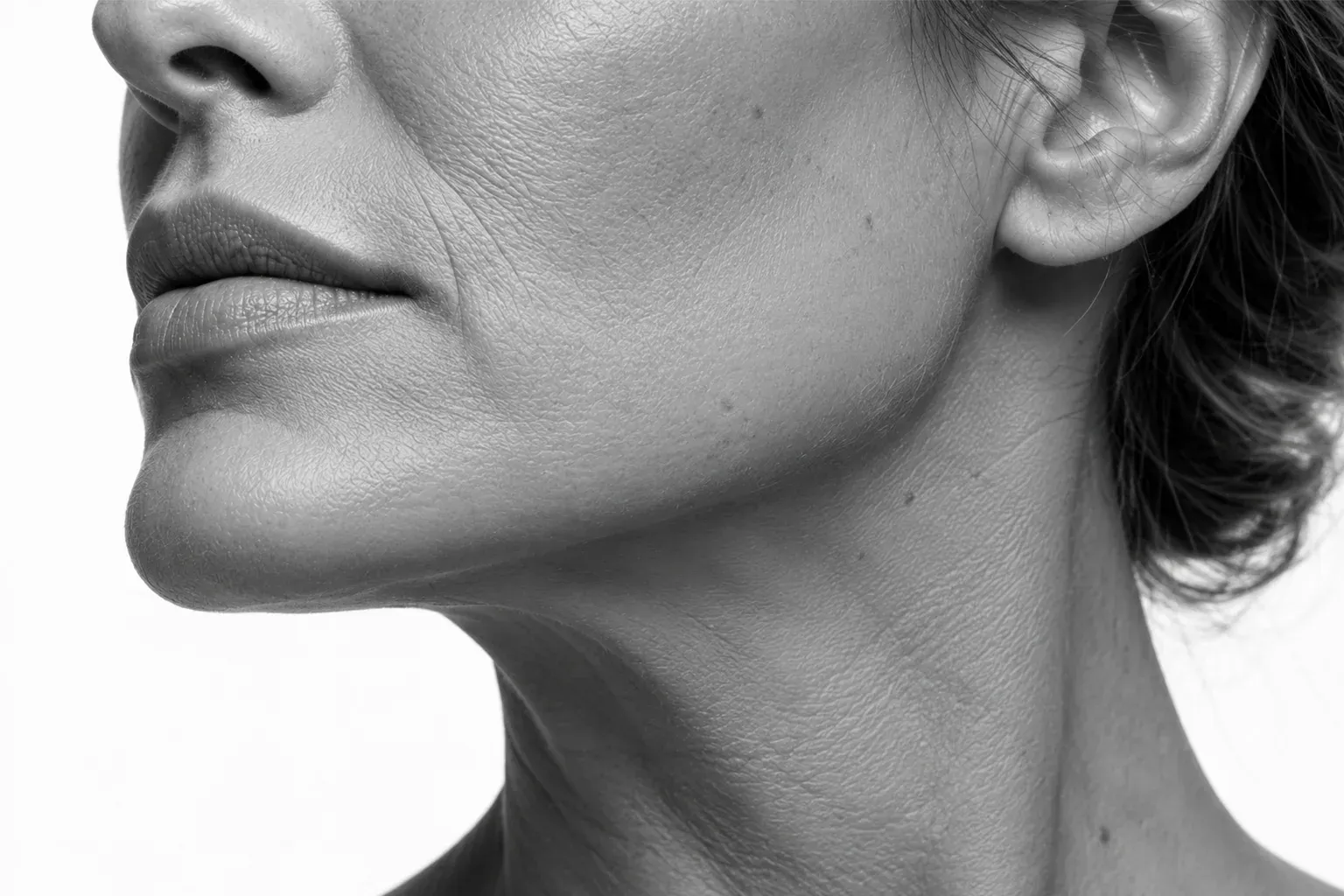
Tissue changes after a previous surgery. Scarring may have formed that binds layers of tissue together where they would normally move independently of one another. Cartilage may have been removed, weakened, or repositioned. Blood supply can be affected by the first procedure. And the external shape of the nose often reveals only limited information about what's actually present underneath.
A revision, then, isn't simply a second version of the same operation. It's a different procedure, working from a different starting point — and with a different kind of uncertainty.
Why Scar Tissue Fundamentally Changes the Operation
In an unoperated nose, tissue layers are usually reasonably distinct from one another. Skin, the soft tissue beneath it, cartilage, and bone each have their own character, and a surgeon can orient by these layers during surgery.
After a previous operation, that distinction is often less clear. Scar tissue can fuse layers together in places where they would normally separate cleanly. This doesn't just complicate access to the structures underneath — it also makes it harder to predict how the tissue will behave during and after surgery.
This altered tissue quality is one of the main reasons a revision typically takes longer and is technically more demanding than a first operation, regardless of how experienced the surgeon is.
When Cartilage Is Missing
Part of a nose's structural stability depends on the cartilage available, particularly around the tip and the dorsum. In a first operation, a surgeon usually has access to the patient's own septal cartilage, sometimes supplemented with cartilage from the ear.
If septal cartilage was already taken, or the remaining material weakened, during a previous operation, that resource may no longer be available in sufficient quantity or quality for a revision. This can mean other donor sites — the ear, or in more extensive cases the rib — need to be considered. Exactly when this step becomes necessary, and when septal or ear cartilage still suffices, is complex enough to deserve its own, more detailed discussion. Not every revision requires rib cartilage, but the question of where the necessary material will come from is one of the decisions that sets a revision apart from a first operation.
Why a Nose Can Become Crooked Again After the First Operation
A crooked nose is one of the more demanding starting points in rhinoplasty — including after a correction has already been performed.
The reason rarely lies in a single crooked bone. Often the nasal bones, septum, and cartilage structures are asymmetric to varying degrees, and sometimes the face itself carries a degree of underlying asymmetry. During surgery, these structures can be straightened and repositioned. Afterward, though, the tissue remains biologically active rather than static.
Cartilage carries something like a mechanical memory of its original curvature and can drift gently back toward that shape over months. Scar tissue, for its part, develops tension as it heals, which can pull surrounding structures subtly out of their new position. Both effects are part of a normal healing process rather than necessarily a surgical error — but they explain why even a carefully straightened nose can gradually shift back toward a slightly crooked appearance over time.
This behavior plays a larger role in a revision than in a first operation, because the tissue involved has already been manipulated once and tends to respond more readily to renewed change.
Can a Nose That Was Made Too Small Be Rebuilt?
When a previous operation removed too much — a dorsum reduced too far, a tip left too short, or a nose that ended up too small overall — missing structure can, in principle, be reconstructed with cartilage. This is one of the more demanding tasks in revision surgery.
What's missing can't simply be added back in, as it might first sound. A newly built cartilage framework has to be stable, has to suit the existing anatomy, and has to be accepted by skin that has already been operated on and is often scarred. And this is where an important, often underestimated limit comes in: a framework can be enlarged — the skin covering it cannot be stretched indefinitely. A soft-tissue envelope that has adapted to a smaller nose over months or years doesn't yield without limit, even when the framework underneath regains more volume.
Part of revision surgery, then, is an honest assessment of how much reconstruction the existing tissue will actually allow — independent of what might be technically achievable at the level of structure alone.
Why a Revision Can't Be Fully Planned in Advance
A careful examination, photographs, sometimes endoscopy, and the documentation of the first operation all provide important clues. Even so, the complete anatomical picture sometimes only becomes clear during surgery itself.
From the outside, it isn't always possible to know with certainty how much cartilage actually remains, how strongly particular structures have fused together, or how extensive the scarring at a given point really is. This doesn't mean a revision begins without a clear plan — quite the opposite. It means a good plan anticipates several possible scenarios and allows the surgical strategy to adapt to what's actually found.
In revisions, then, precision alone isn't enough. Flexibility during the operation is part of the planning as well — a quality that's harder to standardize than a fixed, step-by-step sequence.
Why Function Plays a Larger Role in Revisions
In a first rhinoplasty, the aesthetic change is often, though not always, the main focus. In revisions, that balance frequently shifts: the first operation has, not infrequently, left some degree of functional impairment — a weakened or collapsing nasal valve limiting airflow, for instance.
A revision often has to pursue two goals at once — improving the external shape and restoring or preserving function — whereas in a first operation, function is usually still intact and mainly needs to be protected rather than rebuilt. This dual objective adds to the complexity of planning, since aesthetic and functional priorities have to be weighed against each other when they can't be fully achieved at the same time.
Is a Second Rhinoplasty Always a Major Operation?
Not necessarily. Revision rhinoplasty covers a wide spectrum — from a small, clearly contained irregularity to a nose that needs to be rebuilt almost entirely from a structural standpoint.
The simple fact that a nose has been operated on before, then, says relatively little about how extensive a revision will actually be. What matters is what needs to change and what the anatomical situation genuinely looks like after the first operation. A seemingly small aesthetic correction can turn out to be demanding if it sits in a heavily scarred area — and conversely, not every revision automatically means extensive reconstruction.
When Is the Right Time for a Second Operation?
A nose needs time after rhinoplasty. Swelling can persist for many months, particularly around the tip, and scar tissue continues to change over an extended period as well. What looks like a permanent irregularity a few months after surgery can therefore still resolve.
A revision should generally only be planned once the first operation has healed sufficiently and the tissue has stabilized. How long that takes depends on the nature of the first operation, individual skin characteristics, and personal healing patterns — for many patients, that means roughly a year or longer. In cases of significant functional problems or particular circumstances, an earlier assessment can make sense, but that remains the exception.
Not every dissatisfaction in the first months after an operation means a revision is actually needed. Sometimes the most sensible course of action is simply to wait.
Why Absolute Symmetry and Perfection Can't Be Promised in Revisions
Patients who decide on a revision have often already been through an operation with an unsatisfying result. The wish for a result that's as close to perfect and fully symmetrical as possible is understandable — but it can be guaranteed even less in a revision than in a first operation to begin with.
The altered tissue quality, possible missing structure, scar tension, and the limited predictability of the healing process together mean that a revision realistically aims for a meaningful improvement — not a geometrically perfect result. Discussing this expectation openly before a revision is even planned belongs to the most important tasks of the consultation.
Why the Second Consultation Begins Differently Than the First
People considering a revision arrive at a consultation from a different starting point than first-time patients. They've already been through an operation — some are disappointed, some have functional complaints, others are bothered by a single detail, and some want to correct, as quickly as possible, whatever is currently troubling them.
A revision consultation, then, shouldn't begin with what's surgically possible. It should begin with establishing what's actually bothering the patient and where it comes from. Not every visible change can be improved through another operation. Not every asymmetry should be treated again. And not every result that currently looks different from what was expected is already final — sometimes, as described above, it simply comes down to where healing currently stands.
Whether a revision makes sense, whether it's better to wait, or whether another operation isn't the right decision at all, is part of the responsibility a consultation has to carry — particularly after an operation has already taken place.
Conclusion
A second rhinoplasty is more demanding than the first because it works from an altered, less predictable starting point: scar tissue, cartilage that may be missing or weakened, tissue that responds more readily to renewed change, and, often, additional functional questions. A first operation can usually be described as a change to a largely intact structure; a revision is more often a reconstruction, in which missing or weakened structures have to be restored before any aesthetic change becomes possible at all. It therefore realistically aims for a clear, meaningful improvement — not a perfect, fully symmetrical result. This distinction shapes how a revision should be planned, carried out, and ultimately judged.
To learn more about our approach, visit our Revision Rhinoplasty page, or reach out to arrange a private consultation with Dr. med. Simon Zimmermann.
Frequently Asked Questions
Why does a revision operation usually take longer than a first operation?
Because scar tissue makes access to the underlying structures more difficult, and the existing anatomy first has to be carefully assessed before any correction can even be planned.
Does every revision require additional cartilage from elsewhere in the body?
No. Whether and which additional cartilage is needed depends on how much stable material remains from the previous operation. Some revisions can be completed with remaining septal or ear cartilage; others require further material.
Can a revision guarantee a perfectly symmetrical result?
No. Given scar tissue, altered anatomy, and the limited predictability of healing, a revision realistically aims for a meaningful improvement, not geometric perfection.
Why can a previously corrected nose become crooked again over time?
Cartilage can retain a degree of mechanical tendency to return to its original shape, and scar tissue develops tension as it heals. Both effects can gradually shift a nose back toward its original form over the course of several months.
How long should you wait after the first operation before planning a revision?
Often around a year or longer, since swelling and scar tissue continue to change over that period. The exact timing depends on individual healing; in cases of significant functional problems, an earlier assessment may make sense.
Is a revision always more extensive than the first operation?
Not necessarily. The spectrum ranges from small, contained corrections to substantial structural reconstruction. What matters is the actual anatomical situation after the first operation, not simply the fact that a previous surgery took place.
Can a nose that was reduced too much be rebuilt?
In many cases, missing structure can be reconstructed using cartilage. However, the already-operated, often less elastic skin can represent a real limit — independent of what might be technically achievable at the structural level.