

NOSE · DR. MED. SIMON ZIMMERMANN
One nose a day. What specialization really changes.
Rhinoplasty is a procedure where millimetres can make a difference. Focusing consistently on one field means encountering new anatomical variations and complex situations every day. Why specialization, to us, is more than just a word.
There's a difference between a surgeon who performs rhinoplasty occasionally and one who operates on the same structure with high regularity. The difference rarely shows up in basic technique — that can be learned and followed in a textbook. It shows up in the number of decisions made correctly during surgery, often within seconds, in ways no one watching would even register as a decision.
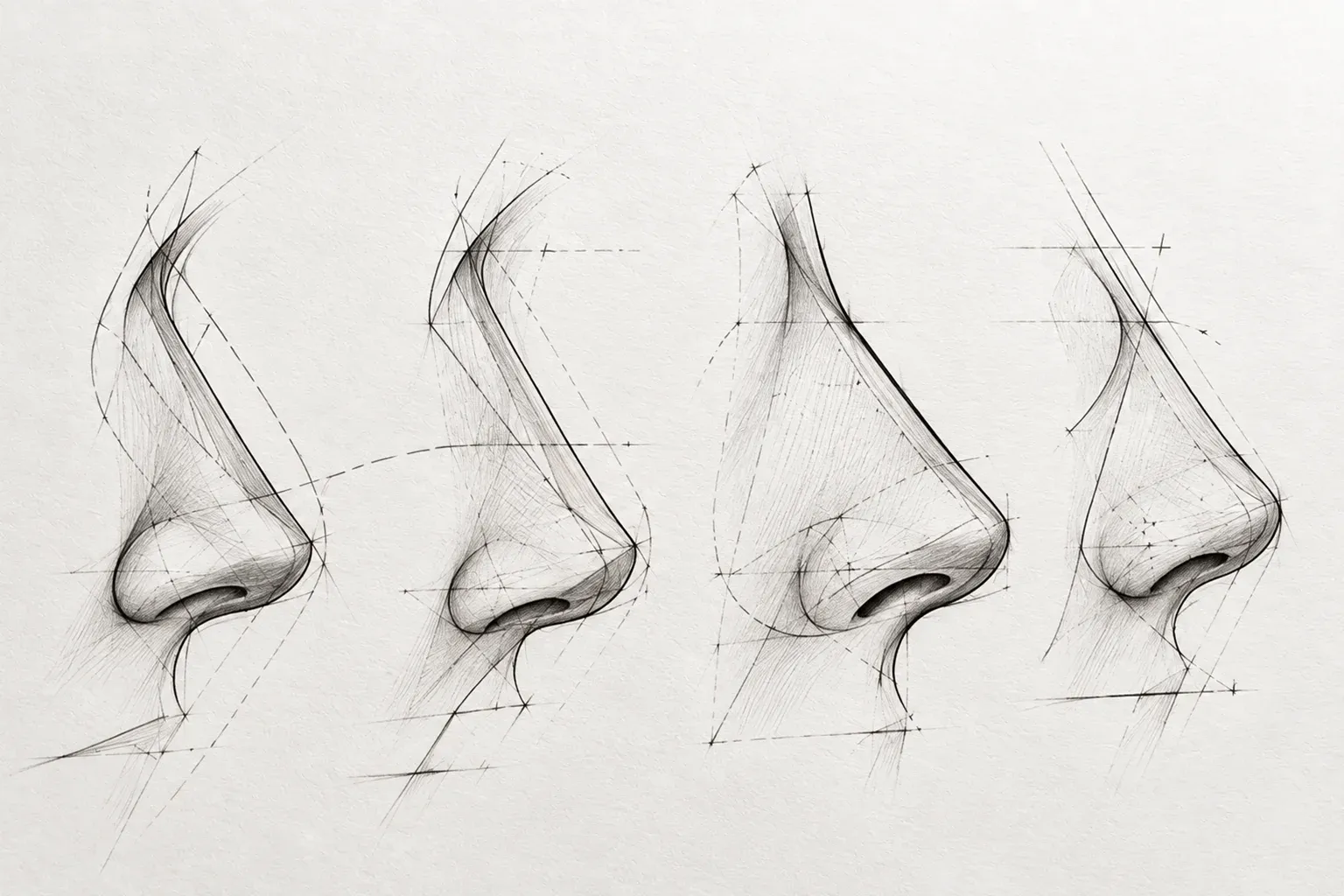
The nose is a particularly demanding example of this. Bone, cartilage, skin, mucosa, scar tissue from previous procedures, and individual healing patterns all converge in a small space. Two noses that look similar at first glance can be built completely differently underneath — and respond quite differently to the same surgical step.
What changes with repeated, focused experience, then, is less the technique itself than the judgment with which it's applied.
Why the Same Request Can Lead to Two Entirely Different Operations
Two patients can arrive with an almost identical request: remove the hump, refine the tip slightly. The sentence is the same. The operation that follows cannot be.
In one, the cartilage is strong and the skin thin, so any adjustment to the tip will remain visible for years to come. In the other, the cartilage is soft and the skin thicker, requiring more structural support to hold the tip's shape long-term. One septum runs straight; the other is markedly asymmetric. In one patient, the dorsum dominates the profile; in the other, a minimal adjustment to the tip alone shifts the perception of the entire face.
The request was identical. The anatomy wasn't — and neither, therefore, can the plan that follows from it.
Why Repetition Is More Than Practice
Repetition is often understood as pure manual skill — as if a movement simply becomes faster or cleaner the more often it's performed. In rhinoplasty, that's only a small part of the story.
The larger part is pattern recognition. After a certain number of operations, a surgeon begins to recognize anatomical variants before they become a problem: a particular cartilage quality that behaves differently during reconstruction, a particular skin thickness that responds more sensitively to a given technique, a particular septal deviation that needs to be corrected in a specific way so it doesn't relapse later.
These patterns don't exist in any textbook in quite this form. They emerge from the accumulation of many individual cases that resemble one another without ever being identical.
What Changes in Surgical Planning
The most visible difference usually doesn't appear in the operating room itself, but before it — in the planning.
A surgeon with a high case volume in a single field develops, over time, a finer sense of how a change in one area will affect another part of the nose. Reducing the dorsum automatically changes how the tip is perceived. Narrowing the tip changes the appearance of the nostrils. These relationships can be explained in theory — but reliably anticipating them, for every new anatomy that walks through the door, is a different skill entirely.
Connected to this is a second shift: the ability to recognize, before surgery even begins, which of a patient's wishes are genuinely compatible with their anatomy and which aren't. This isn't a matter of refusal — it's a matter of honest assessment, and that assessment sharpens with every different starting point a surgeon has seen.
Why a Recognizable "Signature Nose" Works Against the Point of the Operation
Some practices become known for a particular, recognizable nasal shape — one that looks similar regardless of the face it's built on. Aesthetically, this can seem appealing at first glance, because the result appears consistent and clearly defined.
But it describes precisely the opposite of what a good rhinoplasty should achieve. When different faces end up with structurally similar noses, individual anatomy has been made subordinate to a preferred method, rather than the other way around. A recognizable surgical style may function as a signature; as a standard for an individually coherent result, it doesn't hold up.
Growing experience, then, shouldn't produce a fixed repertoire of preferred shapes — it should produce a growing repertoire of possibilities, and the ability to decide freshly, in every case, which of them fits the anatomy at hand. Ideally, what should be recognizable in the result isn't the surgeon's hand. It's the face of the person who was operated on.
Why Function and Aesthetics Can't Be Considered Separately
A rhinoplasty concerns more than appearance. The nose is part of the airway, and its internal structure — particularly the septum and the internal and external nasal valves — plays a major role in how well someone can breathe through it.
A purely aesthetically conceived change that ignores these structures can compromise breathing even when the external result looks successful. The reverse is also true: making a nose smaller is technically a different task than making a nose smaller while keeping it functionally stable. This connection is especially tight in narrow dorsums, pronounced crooked noses, and noses that have already been operated on before.
Repeated exposure to this interplay changes how an operation is planned from the outset: form and function are considered together from the start, not addressed one after the other.
What Difficult Cases Change for Everything Else
The straightforward cases aren't necessarily the ones that teach the most. Particularly challenging starting points — revisions following a previous operation, for instance — force a surgeon to understand anatomy even more precisely, because structures may be missing, scar tissue may have fused tissue layers together, and the original anatomy may be partly unrecoverable.
Cases like these also change how a surgeon approaches an ordinary, first-time rhinoplasty. They make it clearer why preserving existing structure wherever possible matters, why long-term stability outweighs maximal reduction in the moment of surgery, and why a decision that looks inconsequential today can become a problem years later.
Revision cases, in other words, teach something indirectly about the first operation: what is preserved can matter just as much, later on, as what is changed — a point that also bears on why a second rhinoplasty is inherently more demanding than the first.
Why Awareness of Complications Grows Rather Than Fades
A common misconception holds that as experience grows, awareness of possible complications diminishes, because "it's been done so many times already." It tends to work the other way around.
Someone who has performed many rhinoplasties has usually also seen the rarer, more difficult courses of healing — not necessarily their own, but enough of them to know where the real risks lie and where they're overestimated. That changes how carefully a surgeon proceeds at certain points, even when a step looks straightforward at first glance.
Why Specialization Also Means Knowing Where the Limits Are
Part of what develops through focused experience is, somewhat paradoxically, the ability to decide against an operation — or against a particular version of it.
Some anatomical starting points simply don't allow for a realistic version of the result a patient has in mind, at least not without a degree of compromise that should be discussed openly. Recognizing this early and stating it clearly is as much a part of a specialist's responsibility as the technical execution of the surgery itself.
Conclusion
Specialization changes rhinoplasty less at the level of basic technique than at the level of judgment: the ability to recognize anatomical patterns early, to think through form and function together, to anticipate the knock-on effects of individual steps, and to state the limits of an operation clearly when that's what honesty requires. None of this comes from a single well-executed surgery. It comes from repeated, focused engagement with one anatomical area over time — with all its variants, its edge cases, and the lessons that only surface across many cases at once.
To learn more about our approach, visit our Rhinoplasty page, or reach out to arrange a private consultation with Dr. med. Simon Zimmermann.
Frequently Asked Questions
Does more experience automatically mean a better result?
Experience alone doesn't guarantee a particular outcome, since every anatomy is different. It does improve the ability to recognize anatomical particularities early and to assess realistically what's achievable for a given starting point.
Why can two patients with the same request end up with different operations?
Because the request only describes the starting point, not the path to it. Cartilage quality, skin thickness, septal symmetry, and the existing proportion to the rest of the face all determine which surgical approach makes sense in each case.
Is it a good sign if a surgeon is known for a particular nasal style?
Not necessarily. A recognizable style can mean that different faces are ending up with structurally similar noses — which works against a patient's individual anatomy rather than serving it.
Does the risk of complications fall as case volume rises?
Not automatically, but awareness of potential complications usually shifts: someone who has seen many different outcomes can typically assess risk more precisely and proceed with appropriate caution where it's needed.
Why does breathing matter in an aesthetic rhinoplasty?
The septum and the nasal valves are responsible for both external shape and airflow. A change planned purely for aesthetic reasons, without accounting for these structures, can affect breathing.
What does it mean when a surgeon advises against an operation?
It usually means the existing anatomy doesn't realistically support the desired outcome — at least not without a degree of compromise that should be discussed openly.