

BODY · DANIEL QAIYUMI
Correcting Hip Dips With Your Own Fat: What Is Possible?
Hip dips are anatomically normal and cannot be trained away. How your own fat can even out the contour, and why small amounts are safer here.
Hip dips are indentations on the side of the hips that result from body structure and cannot be eliminated with training. With your own fat, the contour can be evened out in a targeted way, often combined with liposuction above and below. Because only small amounts are placed directly beneath the skin, the risk is considerably lower than with techniques in which fat is injected into the muscle.
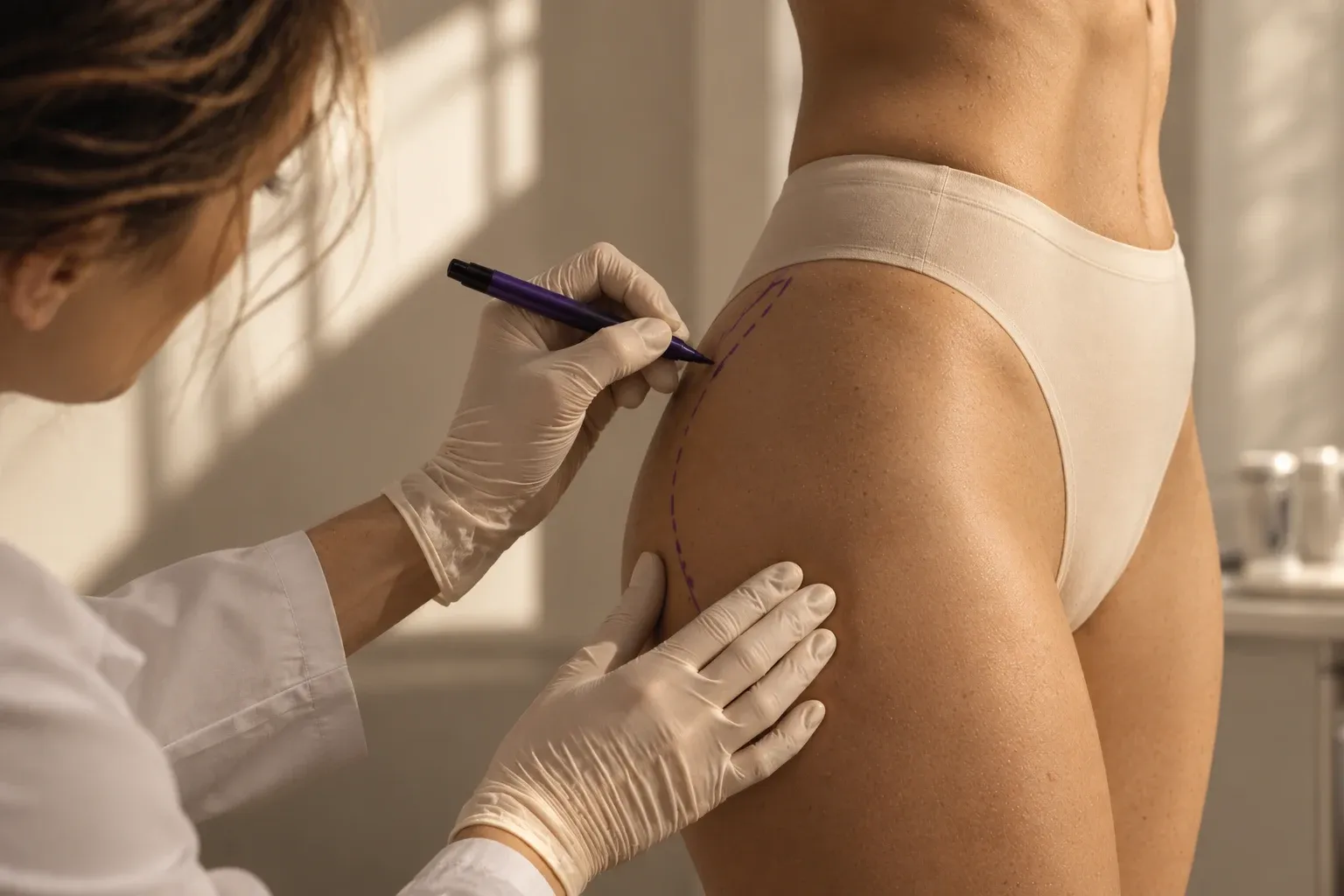
Hardly any body feature is discussed as often on social media as hip dips, also known as violin hips. This refers to the small indentation on the side between the hip and the thigh. Many women train against it for years without any change. This is not due to a lack of discipline, but to anatomy.
How do hip dips develop?
Hip dips develop where the skin on the side of the hip is more firmly attached to the deeper structures, for example in the area of the greater trochanter of the thigh bone. Fat can accumulate above and below this point, but hardly at the point itself. This creates an indentation.
How pronounced it is depends on the shape of the pelvis, the position of the thigh bone and your personal fat distribution. Hip dips are therefore completely normal and not a sign of excess weight or lack of fitness. Training can shape the muscles somewhat, but it does not change how the skin is attached to the deeper layers.
How does correction with your own fat work?
The treatment combines two steps that together create a softer contour:
- Harvesting fat: fat is obtained with gentle liposuction, often from areas where it bothers you anyway, such as the flanks or the outer thighs.
- Placing fat: the processed fat is placed in fine threads directly beneath the skin of the indentation through small puncture sites.
Often it is precisely the combination that makes the difference: when fat is removed above and below the dip and the dip itself is filled, a flowing transition from the waist to the thigh is created. With very firm indentations, I also carefully release the attachments beneath the skin so that the fat can spread evenly.
How safe is fat transfer to the hips?
This question is important, because fat transfer in the buttock area has a bad reputation. Buttock augmentation with your own fat, often called a BBL, was long considered one of the riskiest aesthetic procedures. The reason is well studied: if fat is injected into the gluteal muscles, it can enter the large veins running there and cause a life-threatening fat embolism. With injections into the muscle, mortality is about one case in 3,000 procedures (Felix et al., 2025).
Fat that is placed only beneath the skin, by contrast, does not migrate into these deep vessels (Ghadbane et al., 2026). A meta-analysis of more than 6,000 patients in whom fat was placed exclusively beneath the skin under ultrasound guidance recorded no fat embolism and no deaths (Milani Reis et al., 2025). Professional societies therefore recommend placing fat in the buttock and hip area exclusively beneath the skin. Besides the layer, the amount also matters: the more fat is transferred, the higher the risk (Aad et al., 2026).
When correcting hip dips, and equally for buttock augmentation with your own fat, I therefore follow clear rules: only superficially beneath the skin, never into the muscle, with blunt cannulas and in moderate amounts.
How much of the fat remains?
Not all of the transferred fat survives. Part of it is broken down by the body in the first weeks. How much remains varies from person to person. I therefore plan a slight overcorrection and discuss beforehand that a second, smaller session sometimes makes sense. Fat that is still present after about three to six months generally remains permanently and then behaves like normal fatty tissue. I describe in detail how grafted fat survives biologically in the article Breast augmentation with your own fat: what is realistic?
Who is the treatment suitable for?
- Visible indentations on the side of the hips that bother you
- Enough donor fat on the abdomen, flanks or thighs
- Stable weight, because grafted fat changes with body weight
- Non-smokers, because nicotine impairs graft survival
- Realistic expectations: the goal is a softer, more harmonious contour, not a completely different body shape
In very slim women, there is often not enough donor fat. The options here are limited, and I say so openly during the consultation.
Are there alternatives?
Fillers such as hyaluronic acid can temporarily fill small dips. For the area on the hip, however, large amounts are needed, the result lasts only for a limited time and must be repeated. Training shapes the gluteal and hip muscles and can improve the impression somewhat, but the indentation itself does not disappear. Your own fat has the advantage of being natural to your body, and grafted fat remains permanently.
What happens during the procedure?
- Anesthesia: usually sedation or general anesthesia
- Duration: about one to two hours
- Stay: usually outpatient
- Donor sites: compression garment for a few weeks
- Hips: in the first weeks, avoid lying directly on your side and avoid firm pressure on the treated area
- Work: office work usually after a few days to a week
- Exercise: gradually after about four weeks
- Result: swelling subsides over a few weeks, and the final result becomes visible after three to six months
What are the risks?
More common are swelling, bruising and temporary numbness at the donor and treatment sites. Small lumps from dead fat, oil cysts, irregularities or asymmetries are possible, as is lower volume retention than hoped. Infections are rare. Because treatment takes place exclusively beneath the skin and with small amounts, the risk of fat embolism is very low.
Conclusion
Hip dips are anatomical and not a flaw. If you nevertheless find them bothersome, they can be evened out in a targeted way with your own fat, ideally combined with liposuction above and below. Decisive for safety are the right layer and a moderate amount: only beneath the skin, never into the muscle. For me, these rules apply to every fat transfer to the hips and buttocks.
If you would like to know whether the treatment is an option for you, book a free 15-minute video consultation or a free in-person consultation at Clinic Selnau in Zurich. You can reach us via the Contact page.
You can find more about combined concepts under Body Contouring, and the costs under Prices.
Frequently Asked Questions
Can you train away hip dips?
No. Training can shape the muscles and improve the overall impression. However, the indentation results from bone structure and the firm attachment of the skin to deeper structures, and this does not change with training.
Is hip dip correction the same as a BBL?
No. In a BBL, the entire buttocks are enlarged with larger amounts of fat. In hip dip correction, smaller amounts are placed specifically into the side indentation. The same rule applies to both in my practice: the fat goes only beneath the skin, never into the muscle.
How much fat is needed for hip dips?
That depends on the depth of the indentation. Compared with a buttock augmentation, the amounts are small. Exact planning takes place during the examination.
Is the result permanent?
Fat that has survived after three to six months generally remains permanently. With significant weight loss or gain, however, it changes like normal fatty tissue.
When will I see the result?
Immediately after the procedure, the hip looks fuller than later due to swelling and slight overcorrection. The final result becomes visible after three to six months.
What if I am very slim?
Then there is often not enough donor fat for a visible effect. During the consultation, I check how much fat is available and say openly if the method is not suitable.
Sources
- Felix G.A.A. et al. Assessing Risks in Intramuscular Fat Grafting: A Systematic Review and Meta-Analysis of Complications. Plast Reconstr Surg. 2025;156(3):411-420. doi.org/10.1097/PRS.0000000000012117
- Ghadbane C. et al. Cannula characteristics and mortality risk in Gluteal Lipofilling: does diameter and tip design matter? A narrative review. JPRAS Open. 2026;52:330-336. doi.org/10.1016/j.jpra.2026.08.037
- Aad S. et al. Fatal fat embolism in cosmetic surgery: Comparing gluteal fat grafting to other lipofilling procedures. JPRAS Open. 2026;51:475-484. doi.org/10.1016/j.jpra.2026.07.006
- Milani Reis A. et al. Ultrasound-Guided Gluteal Fat Grafting: What is the Evidence? A Systematic Review and Meta-Analysis. Aesthet Surg J. 2025;46(1):57-62. doi.org/10.1093/asj/sjaf059