

BODY · DANIEL QAIYUMI
Renuvion: What Skin Tightening Without a Large Incision Can Achieve
Between firm skin and a lifting operation there is a gray zone. That is exactly where Renuvion comes in. What the method can and cannot do.
Renuvion tightens the skin from the inside, through the same small access points as liposuction. The method is suited to mild to moderate laxity, where liposuction alone is not enough but a lifting operation with a long scar would still be too much. It cannot replace the removal of genuine excess skin.
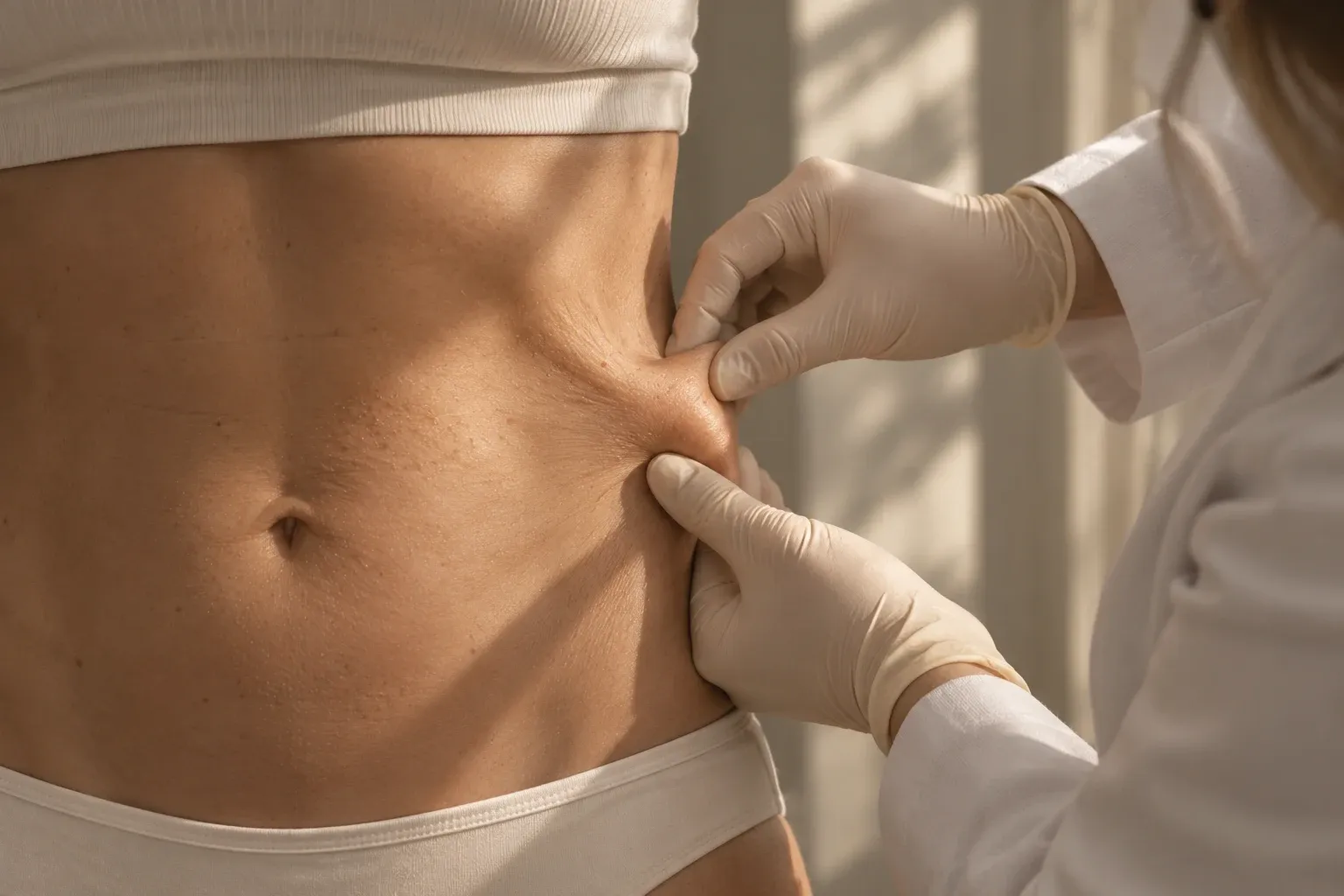
In a liposuction consultation, there is often a moment when I take the skin between two fingers and let go. If it springs back immediately, liposuction is usually enough. If there is clearly excess skin hanging over, a lift with an incision is needed. In between lies a group of patients for whom there was no good solution for a long time. For them, I use Renuvion at Clinic Selnau in Zurich.
What is Renuvion?
Renuvion is a device that delivers radiofrequency energy via a fine stream of helium plasma. The treatment does not take place on the skin, but beneath it. A thin probe is guided under the skin through the small liposuction incisions. There, within fractions of a second, the energy heats the connective tissue network that links the skin to the deeper layers.
The heat causes this connective tissue to contract immediately. Over the following months, the body also builds new collagen. As a result, the skin drapes more closely over the new contour. The helium plasma ensures that the energy acts very precisely and that the heat spreads only minimally into the surrounding tissue.
How well is the effect supported by evidence?
Renuvion is among the better-studied methods for tightening skin from beneath. A recent systematic review analyzed 34 studies with a total of 3,508 treated patients. Average satisfaction was 92 percent. The complication rate was 5 percent when used alone and 8 percent in combination with liposuction (Shridharani et al., 2026).
A small ultrasound study shows how much the tissue contracts: after power-assisted liposuction, Renuvion reduced the distance between the skin and the deep connective tissue layer by an additional 44 percent on average (Nichols and Albershardt, 2024). The greatest effect occurred during the first treatment pass.
To be honest, most studies are retrospective analyses from single centers, and large randomized comparative trials are still lacking. In the United States, Renuvion has been cleared by the FDA since 2022 for lax skin on the neck and chin, and since 2023 for use following liposuction.
Who is Renuvion suitable for?
Renuvion makes sense when the skin has lost elasticity but there is no significant excess yet. Typical situations are:
- Liposuction with borderline skin, for example after pregnancies or with increasing age
- Abdomen and flanks, when the skin might look slightly uneven after liposuction
- Upper arms and inner thighs, where the skin is naturally thin
- Neck and chin, with early laxity beneath the chin
- Knees and back, for example small skin folds along the bra line
Results are best in people with a stable weight who do not smoke and whose skin still has some natural elasticity.
Where are the limits?
Renuvion tightens tissue but does not remove skin. If a skin fold hangs over the waistband, if the abdomen is clearly lax after pregnancies, or if there is diastasis recti, a tummy tuck remains the right approach. The same applies to upper arms with significant excess skin, where an arm lift helps.
Anyone who expects Renuvion to avoid a lifting operation will be disappointed. Those who understand what the method is designed for, however, often benefit considerably: the skin settles better after liposuction, and some patients are spared a long scar. I describe how I decide whether liposuction is enough in the article When is liposuction the right solution?
Renuvion in Zurich: how the treatment works at Clinic Selnau
At Clinic Selnau, I usually combine Renuvion with liposuction using the MicroAire PAL system. First the excess fat is removed, then Renuvion is applied through the same access points. No additional scars are created.
- Anesthesia: depending on the extent, sedation or general anesthesia, smaller areas also under local anesthesia
- Duration: depending on the area, Renuvion adds about 15 to 45 minutes to the operation
- Compression: compression garment for about six weeks
- Work: office work usually after one week
- Exercise: gradually after about four weeks
Swelling may last somewhat longer after Renuvion than after liposuction alone. The tightening develops over several months, as the body slowly remodels collagen. The final result becomes visible after about six months.
What are the risks?
Renuvion works with heat. Its safety therefore depends heavily on correct dosing and experience. More common are prolonged swelling, fluid collections (seromas), bruising and temporary changes in sensation. Rare are skin burns or tightening that turns out weaker than hoped.
A single-center study of 180 treated patients reported complications in 13 percent. Almost all were minor and resolved without intervention, and none required an immediate return to the operating room (Driscoll et al., 2024). The authors emphasize how important proper patient selection is. This matches my own experience.
Conclusion
Renuvion closes a gap that existed in body contouring for a long time: skin that is too lax for liposuction alone but still too good for a lifting operation. The method is well studied, safe in experienced hands and leaves no additional scars. It does not replace the removal of genuine excess skin. An honest examination of the skin before the procedure is therefore crucial.
If you would like to know whether Renuvion is an option for you, book a free 15-minute video consultation or a free in-person consultation at Clinic Selnau in Zurich. You can reach us via the Contact page. You can find more about combined concepts under Body Contouring, and the costs under Prices.
Frequently Asked Questions
Is Renuvion an operation?
Yes, but a small one. The treatment takes place beneath the skin through incisions just a few millimeters long, usually in the same procedure as liposuction. No long scars are created.
Can Renuvion be performed without liposuction?
Yes. With little fat and mild laxity, for example on the neck, chin or upper arms, Renuvion can be used on its own. In most cases, however, the combination with liposuction works best.
When will I see the result?
Part of the tightening occurs immediately. The larger part develops over three to six months, as the body forms new collagen.
How long does the result last?
The tightening is permanent. However, the natural aging of the skin continues, and major weight fluctuations can change the result.
Does Renuvion replace a tummy tuck?
No. Renuvion tightens tissue but does not remove skin and does not treat separated abdominal muscles. With significant excess skin, a tummy tuck remains the right procedure.
What experiences have patients had with Renuvion?
In a systematic review of more than 3,500 treated patients, average satisfaction was 92 percent. The longer the follow-up, the higher the satisfaction, which fits the slow build-up of collagen (Shridharani et al., 2026).
Renuvion, BodyTite or Morpheus8: what is the difference?
Morpheus8 is radiofrequency microneedling. Fine needles deliver the energy into the skin from the outside. This mainly improves skin texture and mild laxity, for example on the face (Kumar et al., 2026). BodyTite and Renuvion, by contrast, work beneath the skin and are usually combined with liposuction. BodyTite uses one electrode inside and one outside the skin, while Renuvion uses a helium plasma through the liposuction access points. Direct comparative studies between the devices are still scarce. More important than the device are the right indication and the surgeon's experience.
Is Renuvion painful?
During the treatment, you feel nothing thanks to anesthesia. Afterwards, it feels similar to the muscle soreness after liposuction and can be managed well with common pain medication.
Sources
- Shridharani S.M. et al. Helium Plasma Radiofrequency for Aesthetic Subdermal Treatment: A Systematic Review and Meta-Analysis. Aesthet Surg J Open Forum. 2026;8:ojag092. doi.org/10.1093/asjof/ojag092
- Nichols C., Albershardt D. Tissue Contraction With Helium-Based Plasma Radiofrequency Technology: A Preliminary Report of Initial Ultrasound Findings. Aesthet Surg J Open Forum. 2024;6:ojae104. doi.org/10.1093/asjof/ojae104
- Driscoll C.R. et al. Expansion of Renuvion Application to Areas Beyond the Submental Region: Review and Experience. Aesthet Surg J Open Forum. 2024;6:ojae041. doi.org/10.1093/asjof/ojae041
- Shridharani S.M., Kennedy M.L. Safety of Helium-based Plasma Technology for Coagulation of Soft Tissue: A Retrospective Review. Aesthet Surg J Open Forum. 2022;4:ojac081. doi.org/10.1093/asjof/ojac081
- Kumar N. et al. Effectiveness of Radiofrequency Microneedling in the Treatment of Dermatological Conditions: A Systematic Review. Aesthetic Plast Surg. 2026;50(13):5282-5317. doi.org/10.1007/s00266-026-05834-y
- Apyx Medical: FDA 510(k) clearance for coagulation of subcutaneous soft tissues following liposuction, April 2023. businesswire.com