

BREAST · DANIEL QAIYUMI
Breast Lift With or Without an Implant: What Does Your Breast Need?
A breast can sag, lose volume or both. What has changed determines whether a lift is enough or an implant should be added.
A breast can sag, lose volume or both. A breast lift raises and reshapes the breast, while an implant replaces lost volume. Whether you need one of them or both depends on what has actually changed in your breast.
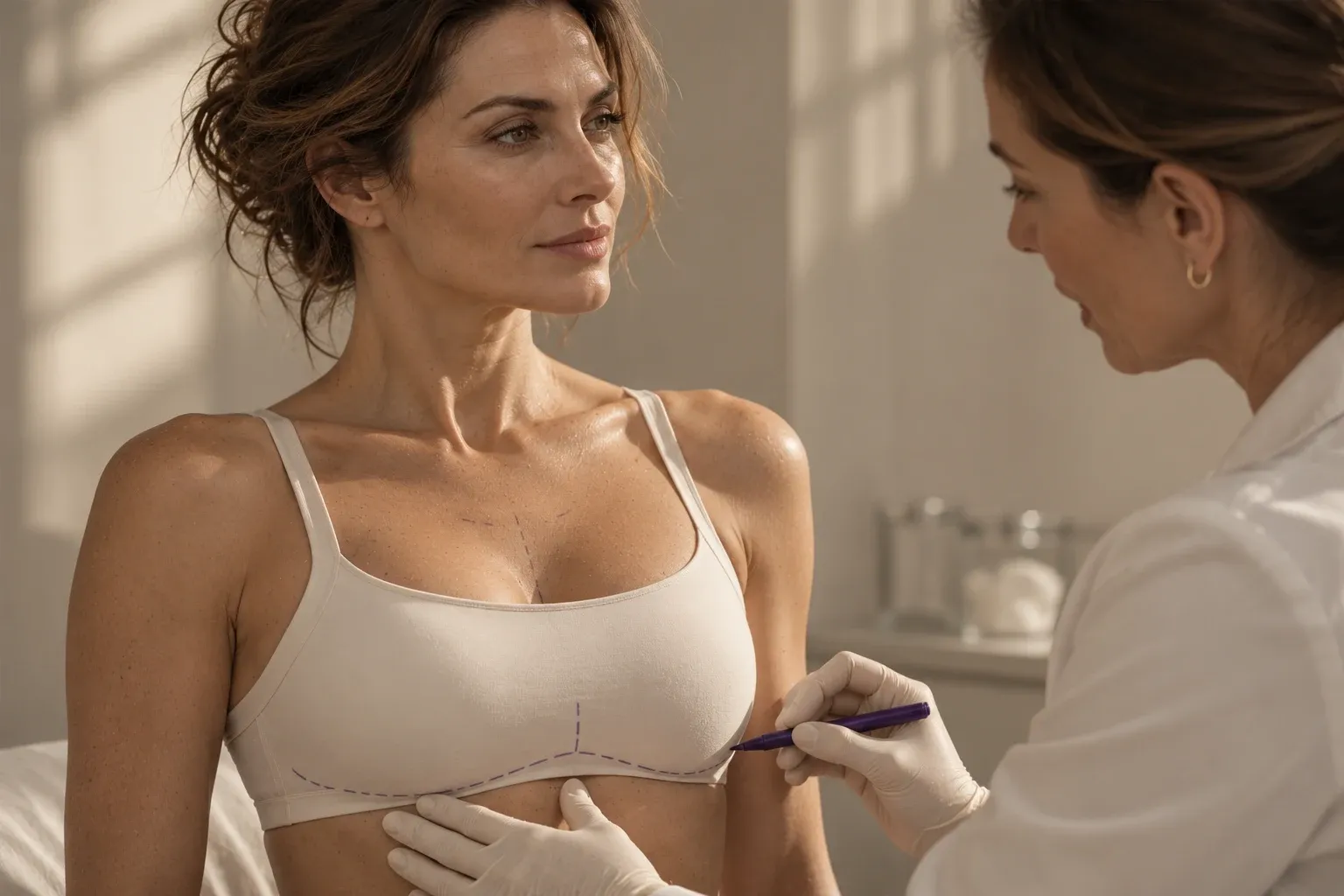
After pregnancies, breastfeeding or significant weight loss, the breasts of many women change considerably. In consultations, I often hear two wishes at the same time: the breast should sit higher again, and the décolleté should look fuller. Both sound similar, but they require different solutions.
Sagging breast or empty breast: what is the difference?
A sagging breast can be recognized mainly by the position of the nipple. If it lies at the level of the inframammary fold or below it, the breast has dropped. The skin has stretched, and the breast tissue has moved downwards.
An empty breast, by contrast, has mainly lost volume. The nipple is still in the right place, but the upper part of the breast looks flat and the skin a little too loose. Many women have a mixture of both.
This distinction is crucial, because it determines the procedure:
- Dropped breast with sufficient volume: breast lift without an implant
- Empty breast without significant drop: breast augmentation with an implant or your own fat
- Dropped and empty breast: breast lift combined with volume
When is a breast lift without an implant enough?
If there is enough of your own breast tissue, a lift alone is sufficient. The nipple is moved to the right position, excess skin is removed and the breast tissue is reshaped. The breast does not become larger, but it looks firmer, rounder and more youthful.
In some women, tissue from the lower part of the breast can be moved upwards to fill the upper pole slightly. This technique is called auto-augmentation. It does not add much volume, but it can noticeably improve a lift without any foreign material.
When do you also need an implant or your own fat?
If the upper part of the breast still lacks fullness after the lift, additional volume can make sense. This can be an implant or, for a moderate wish, your own fat. I describe what is realistic with fat transfer in the article Breast augmentation with your own fat: what is realistic?
One thing is important: an implant alone does not lift a dropped breast. If only an implant is used when the breast has clearly dropped, the breast often sits on the implant instead of with it. The nipple then points downwards and the shape looks unnatural. I explain how I plan the right implant size and position in the articles How big is too big? and Above or below the muscle?
Lift and implant in one operation?
In many cases, a lift and an implant can be combined in one operation. A large systematic review of 4,856 procedures found a complication rate of 13 percent. The most common were a renewed drop of the breast and unattractive scars. About one in ten patients needed a revision procedure (Khavanin et al., 2014).
The combined procedure is more demanding than either step on its own, because the implant stretches the breast from the inside while the lift reduces the skin. With a very pronounced drop or thin skin, it can therefore be safer to proceed in two steps: the lift first, then the volume a few months later.
Which incision pattern is right?
The scars depend on how much the breast has dropped:
- Around the areola: for a mild drop. The scar lies at the edge of the areola.
- Vertical ("lollipop"): for a moderate drop. An additional scar runs vertically down from the areola.
- Inverted T or L-scar: for a pronounced drop or a lot of excess skin. A further scar lies in or along the inframammary fold.
Shorter scars are not always better. An incision that is too small for a pronounced drop often leads to a flat shape or a quick renewed drop. The goal is the shortest scar that allows a stable result. For the L-scar, a variant with a shorter scar in the inframammary fold, a meta-analysis of more than 3,000 patients found a satisfaction rate of 92 percent with low complication rates (Machado Magalhães et al., 2026).
Is it possible without surgery?
Devices are repeatedly advertised as a "breast lift without incisions," for example radiofrequency or helium plasma treatments. A systematic analysis of the available studies found no relevant lifting of the breast on standardized, measured photographs (Swanson, 2026). For a dropped breast, surgical lifting remains the standard. Even Renuvion, which I use specifically for skin tightening on the body, does not replace a lift on the breast.
When is the right time?
- Family planning completed: another pregnancy can change the breast again.
- Stable weight: ideally for several months.
- Time since breastfeeding: at least six months after weaning, so that the tissue has settled.
- Up-to-date breast examination: before the procedure, depending on your age and medical history.
What happens during surgery and how long is the recovery?
- Anesthesia and duration: general anesthesia, about two to three hours, somewhat longer with an implant.
- Stay: outpatient or with one overnight stay.
- Support bra: day and night for about six weeks.
- Work: office work after about one to two weeks.
- Exercise: after about six weeks, chest exercises later.
- Result: at first the breast often sits a little high and firm. The final shape becomes visible after three to six months.
What risks should you know about?
Every breast lift leaves scars. They are red at first and fade over twelve to eighteen months. Nipple sensation can change temporarily or permanently; in the meta-analysis mentioned above, about one in five patients reported reduced sensation. Other possible effects are asymmetries, wound-healing problems, usually where the scars meet, and a renewed drop of the breast over the years. With an implant, implant-specific risks such as capsular contracture are added.
The ability to breastfeed is preserved with most techniques, because the nipple remains connected to the underlying tissue. However, it cannot be guaranteed.
Conclusion
Whether a breast lift alone is enough or an implant should be added is not decided by the wish for a particular method, but by the findings: has the breast dropped, is volume missing, or both? A lift raises, an implant fills, and an implant alone cannot correct a sagging breast. With the right combination and honest planning, a natural, stable shape can be achieved.
If you would like to know what makes sense for your breasts, book a free 15-minute video consultation or a free in-person consultation at Clinic Selnau in Zurich. You can reach us via the Contact page.
You will find all information on the Breast Lift page, and the costs under Prices.
Frequently Asked Questions
Can an implant lift a sagging breast?
Only with a very mild drop. If the nipple is already at the level of the inframammary fold or below, a lift is needed. An implant alone would make the breast larger, but not higher.
How visible are the scars after a breast lift?
The scars lie around the areola and, depending on the technique, vertically below it and in the inframammary fold. They are red in the first year and then usually fade to fine, pale lines. The exact scar quality also depends on your individual disposition.
Can I still breastfeed after a breast lift?
With most techniques, the connection between the nipple and the glandular tissue is preserved, so breastfeeding is often still possible. However, there is no guarantee. A pregnancy can also change the result.
How long does a breast lift last?
The lift is permanent, but the breast continues to age. Gravity, weight fluctuations and pregnancies can lead to a slight renewed drop over the years. A stable weight helps to maintain the result for a long time.
Can a breast lift be combined with your own fat?
Yes. After the lift, your own fat can gently fill the décolleté without an implant. However, the volume gain is moderate and less predictable than with an implant.
Does health insurance cover a breast lift?
An aesthetic breast lift is not covered by health insurance.
Sources
- Khavanin N. et al. A systematic review of single-stage augmentation-mastopexy. Plast Reconstr Surg. 2014;134(5):922-931. doi.org/10.1097/PRS.0000000000000582
- Swanson E. A Systematic Review of Radiofrequency and Helium Plasma Radiofrequency Alternatives to Mastopexy. Aesthetic Plast Surg. 2026;50(3):1109-1117. doi.org/10.1007/s00266-025-05295-9
- Machado Magalhães P.L. et al. Efficacy and Safety of the L-Scar Technique in Breast Surgery: A Systematic Review and Meta-Analysis. Aesthetic Plast Surg. 2026;50(13):5028-5040. doi.org/10.1007/s00266-026-05869-1